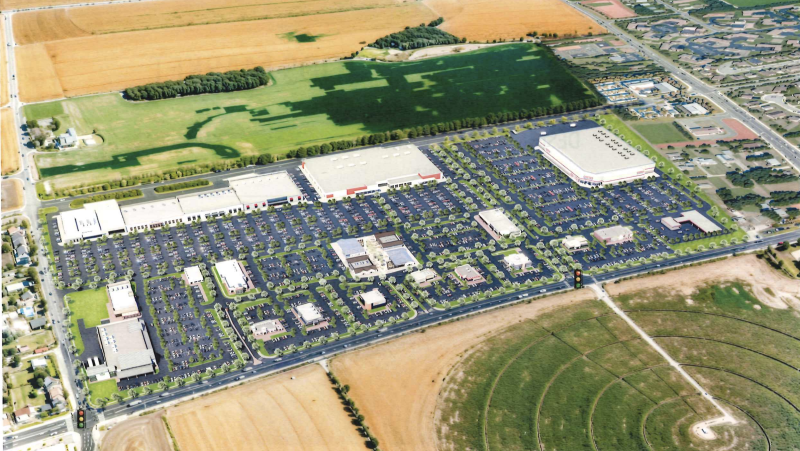
Sussex County Council unanimously denied a zoning change for the proposed 73.5-acre, 665,000-square-foot Atlantic Fields retail development—an estimated $175 million project that proponents said would host anchors such as Costco and Target, plus Nordstrom Rack, Dick’s Sporting Goods, Hobby Lobby and Ross, and create roughly 1,750 permanent jobs. The council cited failures to meet the C-4 mixed-use requirements and overwhelming traffic concerns (projected 26,271 daily vehicle trips versus Route 24 counts of 18,591 year-round/23,713 summer), while DelDOT-mandated road improvements are not scheduled before the project's projected 2028 opening; the developer disputes the decision and next steps are unclear. Investors should view this as a localized regulatory setback that could delay or derail planned retail expansion and affect tenant rollout and regional real estate development pipelines, but it is unlikely to move broader markets.
Market structure: The council’s unanimous denial is a local supply shock — it removes ~665k sq ft of large-format retail from the Rehoboth/Route 24 pipeline, a material reduction for the submarket but de minimis nationally. Immediate winners are incumbent nearby merchants, vacation-rental owners and landowners who avoid added competition; losers are the developer, local contractors and the anchors (COST, TGT, DKS, ROST) that expected a sales lift. Cross-asset: expect modest widening in local muni credit spreads if tax-base growth slows, small negative sentiment in regional construction equities, and negligible moves in US rates, FX or commodities.
Risk assessment: Tail risks include a protracted legal fight (developer appeal) or a policy cascade where other municipalities emulate this stance, delaying 5–10% of targeted expansion projects regionally over 12–24 months. Time horizons: immediate (days) — sentiment and local contractors' stocks can gap; short-term (3–6 months) — earnings/expansion guidance revisions for expansion-dependent retailers; long-term (12–36 months) — potential strategic shift to mixed-use or e-commerce fulfillment vs big-box growth. Hidden dependencies: DelDOT funding/timing is critical — if state accelerates road improvements the project could restart; absent that, approvals are moot.
Trade implications: Tactical short-biased, modest-size bets on expansion-exposed names (ROST, DKS) are warranted for 6–12 months; hedge with 3-month put spreads 5–10% OTM to limit drawdowns. Conversely, treat COST and TGT as buy-on-dip: add 1–2% positions if shares drop >3% within 30 trading days given scale advantage and lower per-store sensitivity. Rotate 2–4% away from development-heavy retail REITs into logistics/warehouse REITs and civil contractors likely to benefit if DelDOT spends on corridor improvements.
Contrarian angles: The market underestimates that denied supply can lift incumbent store economics locally — existing store margins in that micro-market could rise 50–200 bps if traffic stays concentrated. The negative read-through to national tickers is likely overdone; if the developer re-files with a housing component (90–180 days), the project could reappear and reverse local winners/losers quickly. Monitor official appeal/refile filings (30–90 days) and DelDOT corridor funding announcements (6–12 months) as binary catalysts.
AI-powered research, real-time alerts, and portfolio analytics for institutional investors.
Request DemoOverall Sentiment
moderately negative
Sentiment Score
-0.40
Ticker Sentiment
