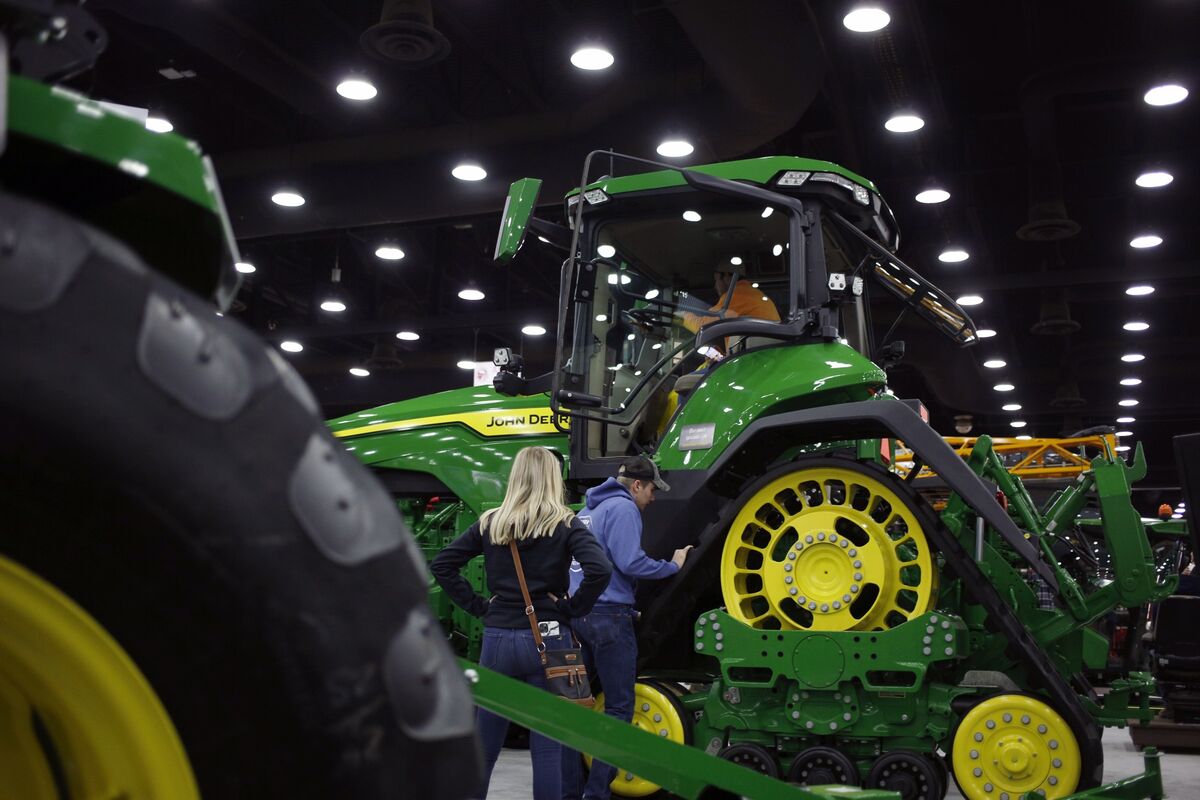
Deere & Co. issued a fiscal-year net income outlook of $4.0 billion to $4.75 billion, missing the average Bloomberg analyst estimate of $5.31 billion, as the timing of a recovery in the US farm economy remains unclear. The guidance shortfall from the world’s largest farm-equipment maker signals weaker-than-expected demand for agricultural machinery and introduces downside risk to earnings and related commodity-linked exposure for investors.
Market structure: Deere (DE) and peers (CNH, AGCO) are direct losers as a delayed US farm rebound reduces new-unit orders and gives dealers leverage to demand deeper incentives; used-equipment marketplaces and aftermarket/service providers (parts, subscriptions) are relative winners as farmers delay capex. Expect OEMs to fight on price and push factory utilization lower over 2–4 quarters, compressing gross margins by 200–600 bps if production rates fall >15% year/year.
Risk assessment: Near term (days–weeks) the market will reprice cyclicals and equipment-finance ABS spreads may widen; short-term risks include weather shocks and USDA acreage reports that can flip sentiment. Tail risks (low probability, high impact) include a localized farm-credit crisis triggering regional bank stress (names with higher ag loan concentration) and cascade write-downs at OEMs if inventory obsolescence forces asset impairments over 6–12 months.
Trade implications: Tactical plays favor protection and relative-value: hedge DE exposure with 3-month puts or put spreads, rotate exposures from capital goods (XLI) into recurring-revenue names (TRMB, subscription/software) and defensive staples (XLP) over 30–90 days. Commodities and fertilizer exposure (MOS/CF) deserve conditional sizing — only add if crop prices remain within 10% of current levels and planting intentions don’t fall more than 5% in the next WASDE cycle.
Contrarian angle: Consensus underestimates aftermarket/service resilience and the long-term premium for precision/autonomy (favors TRMB, top-tier dealers that control trade-ins). The initial sell-off can be overdone — analogous to 2015–16 where OEM margins compressed for 2–3 years but survivors gained share; position sizing and option structures should assume a multi-quarter recovery horizon.
AI-powered research, real-time alerts, and portfolio analytics for institutional investors.
Request DemoOverall Sentiment
moderately negative
Sentiment Score
-0.55
