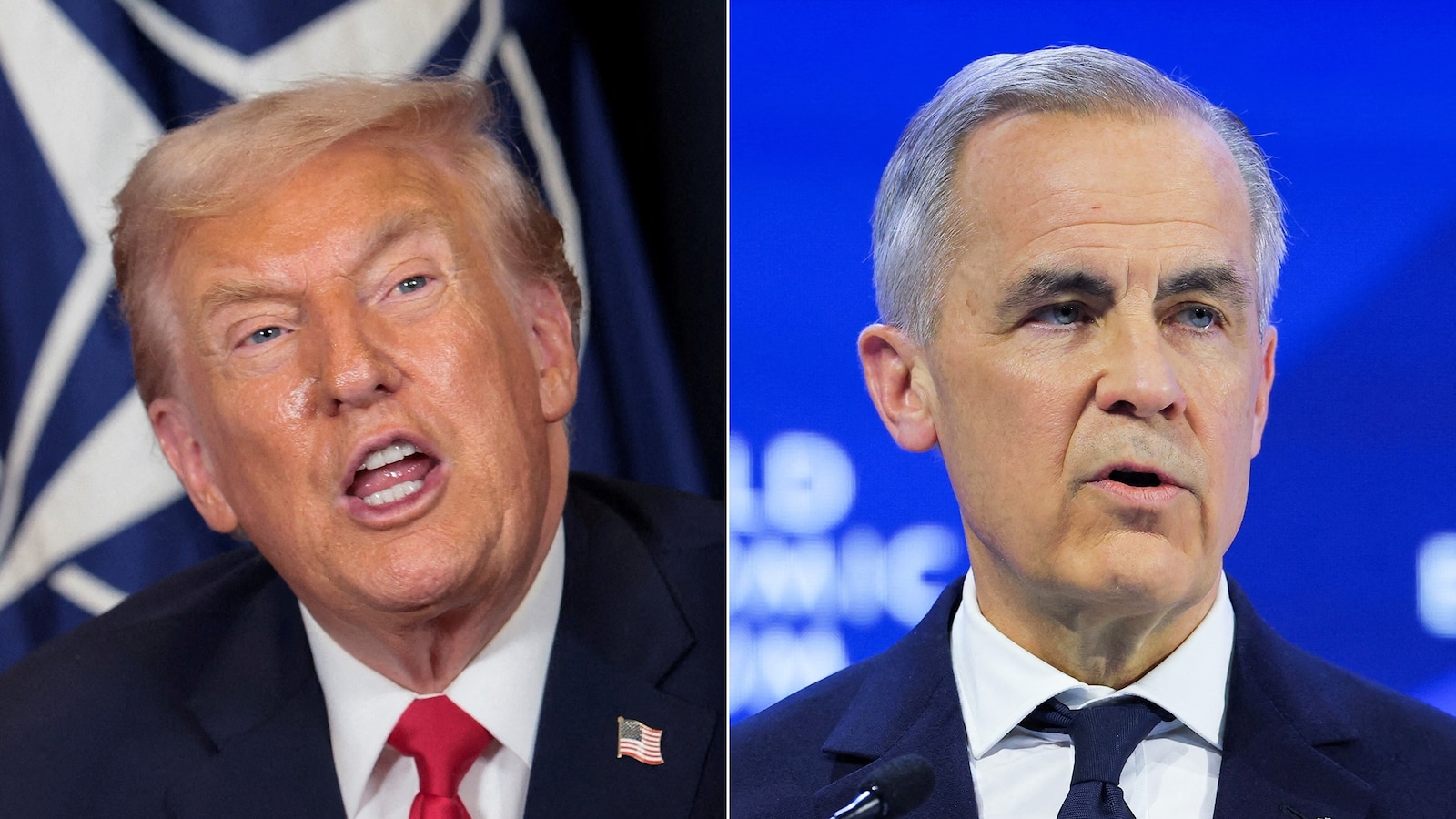
President Trump withdrew an invitation for Canada to join his newly created "Board of Peace" after Canadian Prime Minister Mark Carney warned of a "rupture" in the rules-based international order during a Davos speech. The public spat — including Trump’s references to tariffs and Canada’s dependence on the U.S., and Canada’s rebuttal — underscores rising bilateral political and trade tensions; while several non-European countries have signed the board, key U.S. European allies have declined, creating modest geopolitical and trade risk but limited direct market-moving implications.
Market Structure: A bilateral political spat between Washington and Ottawa raises marginal trade/tariff tail risk that directly hurts Canadian exporters, FX (CAD), and Canada-heavy ETFs (EWC) while modestly benefiting USD safe-haven assets and US import-substitutes. Expect pricing power to shift at the margins: sectors with Canada-centric supply chains (autos, steel, lumber, energy) face upward cost/volatility pressure; U.S. domestic producers of those goods gain short-term pricing leverage if tariffs are implemented. Cross-asset: modest bid for U.S. Treasuries (TLT) and USD; commodity impact is asymmetric—Canadian oil and lumber could underperform global peers if market access is constrained.
Risk Assessment: Tail risks include unilateral tariffs (1–10% duties) within 30–90 days, sudden suspension of bilateral procurement, or reciprocal financial measures (rare but high-impact). Immediate (days): headline-driven volatility; short-term (weeks–months): FX moves of 1–4% and 5–10% swings in Canada-centric small caps; long-term (quarters+) structural re-routing of supply chains if policies persist. Hidden dependencies: integrated US‑Canada auto and energy networks make broad tariffs politically costly—escalation requires clear political trigger. Key catalysts: formal tariff notices, Congressional action, and upcoming trade/WEF statements within 30–60 days.
Trade Implications: Tactical books should short CAD exposure and Canada equities while hedging with US assets: establish a 2–3% notional long USD/CAD (via CME 6C or FX forward) and trim Canada ETF EWC by 2–4% within 1–4 weeks. Options: buy a 3‑month USD/CAD call spread priced to capture a 2–4% move (buy ATM, sell ~+3–4% strike) to cap premium. Rotate 1–3% into US industrials/defense (LMT, RTX) and Treasury duration (TLT) as a hedge against risk-off.
Contrarian Angles: Consensus may overstate permanence—economic interdependence makes full tariff regimes unlikely, so extreme CAD moves could mean-revert. If USD/CAD >+5% move within 60 days, consider mean-reversion trades: buy FXC (long CAD ETF) or re-enter EWC at >7% discount to baseline. Historical parallels (US‑EU trade skirmishes) show initial volatility then limited long-term realignment, so size positions to 2–4% skew and use options to define downside.
AI-powered research, real-time alerts, and portfolio analytics for institutional investors.
Request DemoOverall Sentiment
mildly negative
Sentiment Score
-0.30
