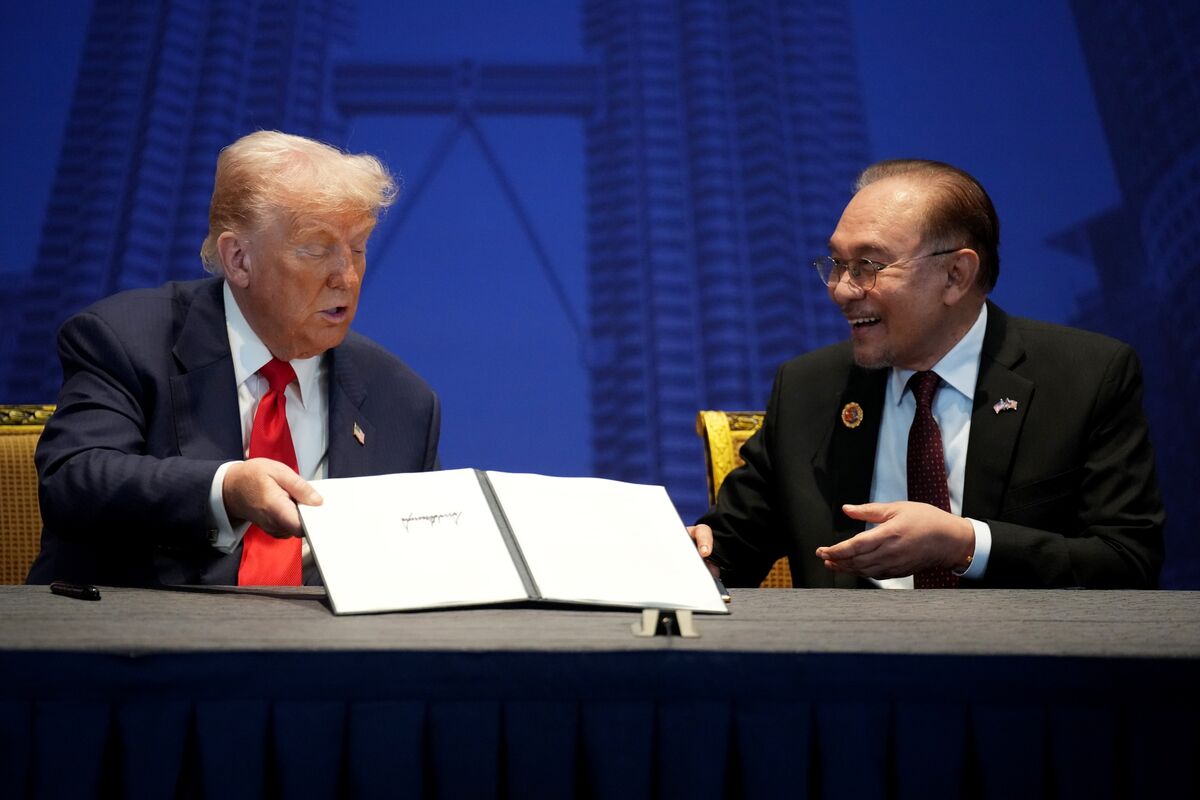
Beijing formally raised objections with Malaysia and Cambodia over trade pacts those countries signed with the U.S. last month, with China's Ministry of Commerce saying it has “grave concerns” about certain provisions of the U.S.–Malaysia deal and urging Malaysia to consider its long‑term national interests. The diplomatic push highlights growing Sino‑U.S. friction over trade alignments in Southeast Asia and creates incremental political and policy risk for regional trade flows and investor sentiment, though it stops short of immediate market‑moving actions.
Market structure: Beijing’s protest raises near-term political risk for Malaysia/Cambodia exposures and increases probability of bilateral frictions that favor US-aligned exporters and geopolitical suppliers (defense, high-tech). Expect Malaysian assets to trade with a risk premium: MYR could weaken ~2-4% and Malaysian 10y sovereign spreads widen 10–30bps over 1–3 months if Beijing escalates. Commodity flows (palm oil, rubber) and electronics assembly that route through ASEAN to China/US will see higher trade-cost volatility.
Risk assessment: Tail risk includes Chinese non-tariff barriers or investment curbs that remove 5–10% of export revenues for targeted Malaysian sectors within 6–12 months, and an adverse scenario where flight-to-safety lifts US Treasury yields and gold. Immediate (days) risk is headline-driven FX/ETF moves; short-term (weeks–months) is policy signaling and negotiations; long-term (quarters–years) is structural decoupling of supply chains. Hidden dependency: corporate revenue disclosure often understates China-dependent tiers (2–3 supplier layers) that can transmit shocks.
Trade implications: Tactical plays should focus on short Malaysia beta and long regional re-allocation to Vietnam/Indonesia exporters, plus defensive gold/defense exposure if volatility rises. Anticipate implied vol on Malaysia-focused instruments to jump 20–40% on escalatory headlines; use 3-month options to time that volatility rather than outright directional leverage. Capital flows may re-rate ASEAN relative valuations by 5–12% if China escalates trade restrictions.
Contrarian angle: The market may underprice the chance Malaysia uses the US agreement to attract Western FDI; if Malaysia resists Beijing, select Malaysian industrials and palm-oil exporters could re-rate higher over 12–24 months. Historical parallels: targeted Chinese pressure (e.g., against Norway) produced short sharp asset moves then normalization; this implies short-duration hedges and selective long-term redeployment into beneficiaries of Western supply-chain diversification.
AI-powered research, real-time alerts, and portfolio analytics for institutional investors.
Request DemoOverall Sentiment
mildly negative
Sentiment Score
-0.30
