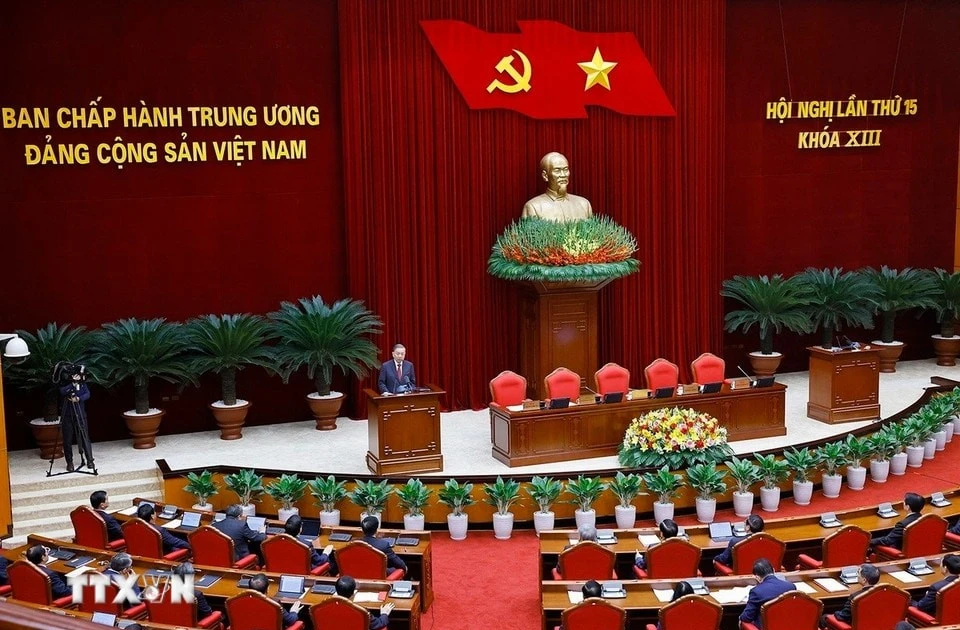
Vietnam's Party Central Committee, led by General Secretary To Lam, hailed decades of reform and unanimously approved personnel reports and nominations to be submitted to the 14th National Party Congress for the 2026–2031 tenure. The committee identified strategic priorities — institutional reform and decentralisation, science, technology, innovation and digital transformation, human-capital development, and infrastructure (transport, technology, energy) — signalling policy continuity that could support infrastructure and tech investment opportunities while emphasising unity and resilience amid global health, climate and geopolitical shocks.
Market structure: The Party’s stated priorities (institutional reform, decentralisation, infrastructure, tech/digital and human-capital upgrades) structurally favour Vietnamese banks (credit intermediation for capex), listed infrastructure/materials, renewables and domestically-facing tech/telecoms. If even a fraction of planned spending is enacted, expect earnings upgrades of 15–30% in these sectors over 12–24 months; export-oriented low-value manufacturing and weak SOEs are the relative losers. Cross-asset: successful reform signaling typically compresses sovereign spreads by 30–80bp and supports VND appreciation; commodity demand for steel, cement and diesel will edge up, modestly lifting regional commodity prices.
Risk assessment: Tail risks include a political shake-up post-nominations, a China-driven external demand shock, or fiscal slippage prompting capital controls — each could cause >20% drawdowns in equities and >100–200bp widening in bond yields. Immediate (days) impact is low; short-term (weeks–3 months) depends on Congress personnel announcements and budget cues; long-term (1–3 years) hinges on implementation of SOE reform and FDI retention. Hidden dependencies: FDI flows, concessional external financing (ADB/World Bank), and China demand; monitor those flows as second-order drivers.
Trade implications: Direct plays: overweight Vietnamese financials, materials and renewables via VNM ETF and selective names (VCB, TCB, VIC) over 6–18 months, accumulating on 5–12% market dips. Use 6–12 month call spreads to express upside with capped cost; implement a pair trade long VNM vs short EEM to isolate Vietnam-specific re-rating. Entry: scale in now and into any 5–10% pullback; trim on +25–35% moves or within 30 days after final Congress fiscal commitments.
Contrarian angles: Consensus underestimates execution risk — markets price political continuity but not implementation frictions; conversely the market may underprice a near-term capex wave if personnel selections catalyse fast budget allocations. Historical parallels: past Vietnamese reform spurts produced concentrated multi-quarter rallies in banks/constructors; unintended consequences include inflation/FX stress from rapid fiscal push, which would flip this theme quickly.
AI-powered research, real-time alerts, and portfolio analytics for institutional investors.
Request DemoOverall Sentiment
mildly positive
Sentiment Score
0.28
