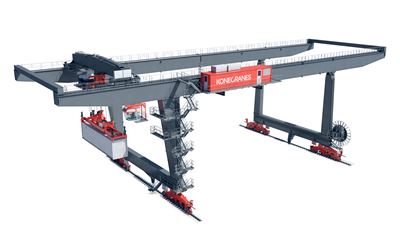
Konecranes secured an order for two rail-mounted gantry (RMG) cranes for a greenfield container terminal in India—booked in Q4 2025 and due to be operational by end-Q2 2027—building on the terminal operator's Q3 2025 purchase of 30 rubber-tired gantry (RTG) cranes for the same site. Each RMG will feature twin-lift spreaders, rotating trolleys and Active Load Control to improve rail-handling precision and integrate yard-to-rail flows; the deal underscores ongoing demand for port equipment in emerging markets and incremental sales for Konecranes (Group sales EUR 4.2bn in 2024). The contract is commercially positive but modest in scale relative to group revenue and is unlikely to be market-moving on its own.
Market structure: The order confirms Konecranes (KCR on Nasdaq Helsinki) is winning integrated RTG+RMG greenfield yard business where rail-yard interface matters — direct winners are Konecranes, Indian terminal operators, and rail/port integrators; smaller specialist RTG/RMG makers without digital/service suites lose pricing power. The deal (30 RTGs booked Q3 2025 + 2 RMGs booked Q4 2025, ops by end-Q2 2027) implies multi-year installation and aftermarket service revenue and modest upward pricing ability for premium, automated kit in emerging-market ports.
Risk assessment: Tail risks include project/financing delays, Indian import/tariff shifts, supply-chain shortages (steel, controls) and a reputational/operational incident that could pause rollouts — low-probability but could delay revenue into 2028. Near-term (days/weeks) market impact is negligible; short-term (3–12 months) monitor order-book and guidance revisions; long-term (12–36+ months) the value is in recurring service & digital products where a single terminal can deliver 3–6% incremental operating margin if scaled.
Trade implications: Primary trade is a selective long KCR exposure to capture order-book + aftermarket upside; supplement with Indian port/infrastructure longs (e.g., ADANIPORTS.NS) to play domestic volume growth. Use a relative-value pair (long KCR, short Terex TEX) to isolate port-automation alpha; express convexity with a Jan 2027 call-spread on KCR sized 1–2% of capital to cap premium costs. Reweight portfolio toward European industrials and Indian infrastructure over 3–12 months if bookings climb >10% YoY.
Contrarian angles: Markets may underprice recurring service cashflows — if Konecranes converts 30–40% of greenfield capex into 3–5% incremental margin, EPS upside is underappreciated. Conversely, consensus may be complacent about client concentration and India-specific political/regulatory risk; similar automation waves (post-2010 container capex) show boom→overcapacity risk, so size positions defensively and hedge project-concentration outcomes.
AI-powered research, real-time alerts, and portfolio analytics for institutional investors.
Request DemoOverall Sentiment
mildly positive
Sentiment Score
0.30
