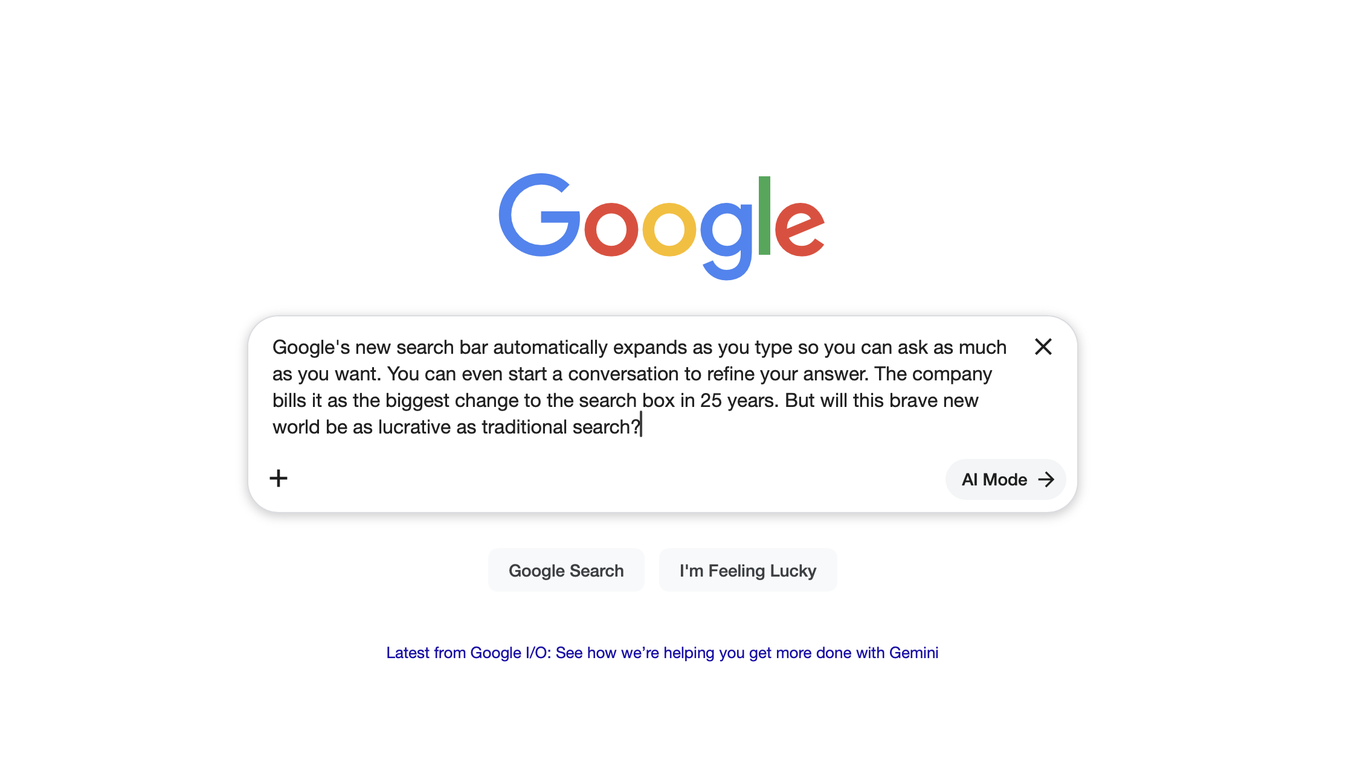
Google is expanding Search into AI-driven, chat-style and agent-based experiences, including longer queries, recurring alerts, and information agents, as it responds to AI chatbot competition. The company also highlighted broader AI rollouts across Gemini, YouTube, Chrome, and new hardware such as AI glasses and Project Aura. The move signals a strategic shift to keep users inside Google's ecosystem and defend the search cash cow, with likely implications for product adoption and competitive positioning.
GOOGL is effectively choosing self-disruption to defend distribution, which is usually the right move when a product has >90% habit share but faces a platform shift. The near-term market likely underestimates how AI-native search will protect query volume while quietly expanding monetization into longer, higher-intent prompts; that can offset some CPC pressure if advertisers pay for better-converting sessions rather than raw clicks. The bigger second-order effect is that Google’s AI layer raises the bar for every standalone chatbot: if search, browser, assistant, and video are integrated, the default consumer workflow becomes harder to dislodge. The real competitive loser is not just a pure-play chatbot, but any company relying on a fragmented discovery stack. META is mildly affected because AI assistants embedded in search and browser reduce the time users spend in open-ended chat interfaces, while Google’s ecosystem can better monetize intent. WRBY is more interesting as a hardware beneficiary: if AI glasses become a recurring interface, eyewear becomes a new distribution channel for ambient search and assistant use, creating an option value that is not fully reflected in retail optics multiples. The key risk is execution and cannibalization timing. Over the next 1-2 quarters, investors may see elevated TAC, model costs, and some query monetization dilution before any product-led gains show up in revenue. Over 12-24 months, if Google proves agents increase retention and ad conversion, the stock can re-rate on durable search moat extension; if not, the market will treat this as defensive feature-bolting that accelerates the shift to alternatives. Consensus may be underpricing how much AI search helps Google more than it hurts it. The market often assumes AI reduces search clicks, but the more important variable is total commercial intent captured per user session; if Google owns the assistant, browser, and hardware surfaces, it can intercept more demand at the moment of need. That makes this less a product announcement than a platform land grab.
AI-powered research, real-time alerts, and portfolio analytics for institutional investors.
Request DemoOverall Sentiment
mildly positive
Sentiment Score
0.20
Ticker Sentiment
