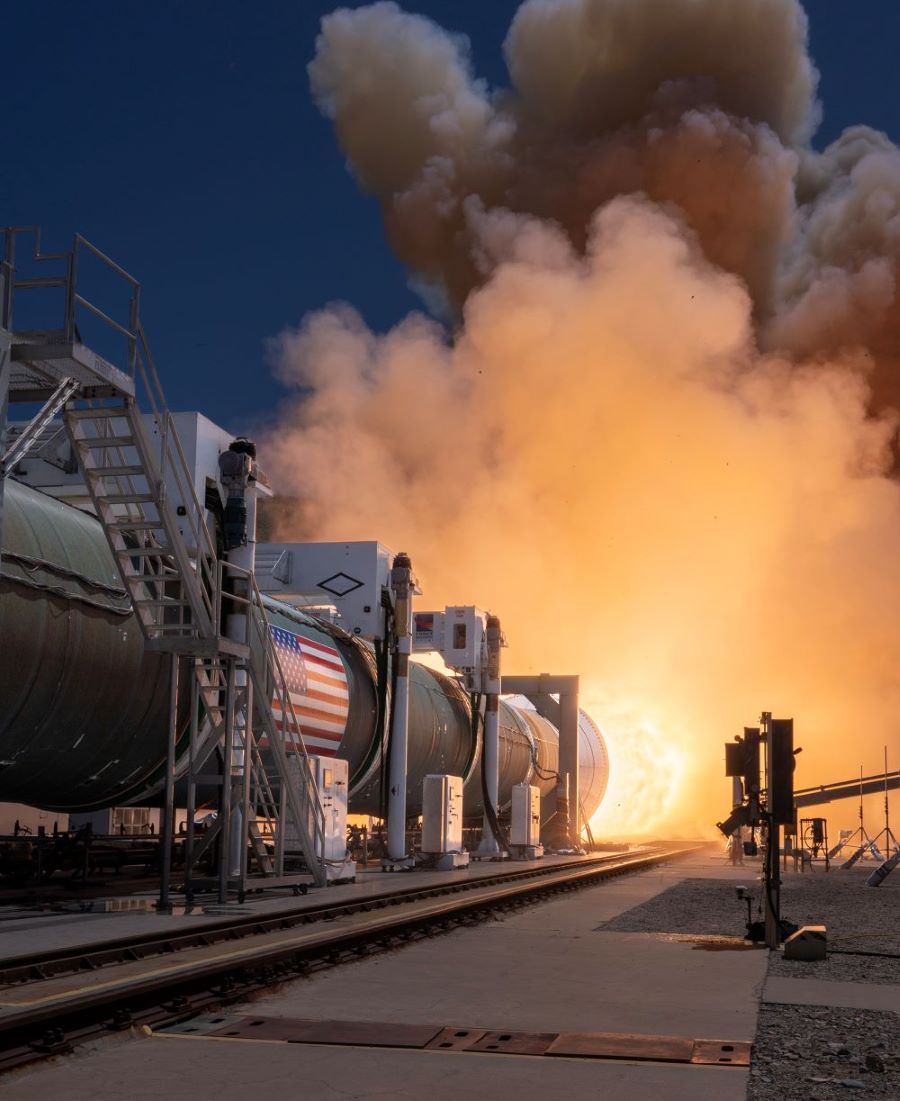
Northrop Grumman conducted a static fire test of NASA’s Booster Obsolescence and Life Extension (BOLE) solid rocket booster, the enhanced five-segment motor designed for human spaceflight, producing over 4 million pounds of thrust. This new design, featuring a composite case and updated propellant, improves performance by over 10% and adds five metric tons of payload capacity to lunar orbit, critical for deep space missions. While the test gathered valuable data, an anomaly was observed near the end of the burn, indicating a need for further design iteration for future developments.
Northrop Grumman's static fire test of its new Booster Obsolescence and Life Extension (BOLE) solid rocket motor marks a significant, albeit mixed, milestone for its space propulsion division. The test successfully demonstrated key performance targets, with the motor generating over 4 million pounds of thrust and validating a design that increases payload capacity to lunar orbit by five metric tons—a greater than 10% improvement over the current Space Launch System (SLS) booster. This advancement, driven by a new composite case and updated propellant, reinforces NOC's technological leadership and its critical role in NASA's long-term plans. Strategically, the BOLE program's emphasis on replacing obsolete components and utilizing a U.S.-based supply chain aligns with national security priorities and enhances operational efficiency. However, the disclosure of an "anomaly" near the conclusion of the burn introduces a notable element of technical risk. While the company frames this as a valuable data-gathering event for design iteration, it signals that further development and testing will be required before the booster is fully flight-qualified, potentially impacting program timelines and costs.
AI-powered research, real-time alerts, and portfolio analytics for institutional investors.
Overall Sentiment
mildly positive
Sentiment Score
0.20
Ticker Sentiment
