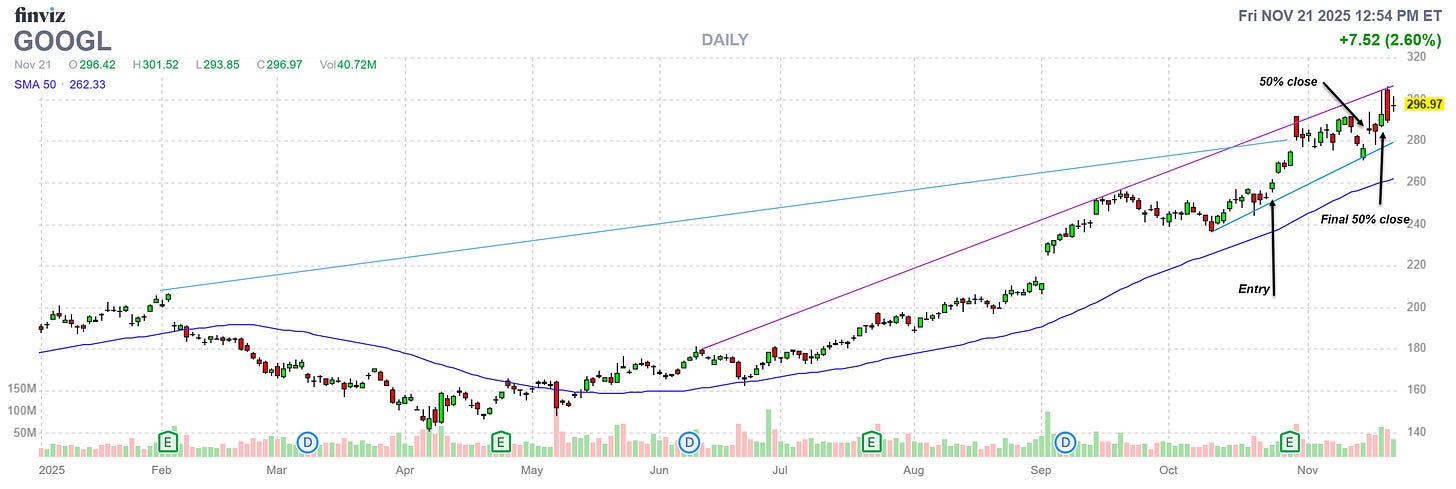
A Vertical Options Trader recommendation to buy a GOOGL Nov. 21 275-300 strike debit call spread (initiated Oct. 17 when GOOGL traded ~$251) produced a 300% gain on a half position when stock hit $291.74 and the remaining half was closed at $299.34 after Berkshire-related buying, delivering an overall 454% profit. The piece highlights how a vertical debit spread — buying an ATM call and selling an OTM call in the same month — limits time decay exposure and caps risk to the net debit, illustrating a risk-managed bullish options trade that capitalized on technical breakout and an ownership-driven catalyst.
Market structure: The GOOGL pop (from $251 to >$300 in ~5 weeks) benefits long-biased equity holders, options debit-spread buyers who limit theta, and index/ETF flows (QQQ, SPY) via market-cap weighting; short-term losers include holders of naked short-dated calls and ad-revenue sensitive small caps that underperform on rotation. The move compresses near-term implied volatility (IV) after the spike, shifts dealer hedging from negative-gamma to more neutral profiles, and increases demand for spread products that cap extrinsic decay while keeping directional exposure.
Risk assessment: Key tail risks are regulatory action (antitrust fines or ad-targeting limits) that could cut top-line by >10% over 12–24 months, a large-scale reversal if a major shareholder (real or rumored) sells >1% of float, or macro shock (hawkish Fed) that reprices growth multiples; probability medium but impact high. Near-term (days/weeks) expect IV compression and pullbacks of 5–12%; medium-term (quarters) fundamentals (ad, cloud) drive 10–20% re-rating ranges. Hidden dependencies: index rebalancing and ETF inflows can create mechanical price pressure; option gamma and dealer flows can amplify intraday moves.
Trade implications: Tactical: use limited-risk directional structures — buy 8–12 week GOOGL bull call spreads (e.g., 280/305) sized to risk 0.5–1% portfolio for targeted 2–3x payout, close at 50% realized gain or $330 price. Income: after IV pop, sell 10–18 day 5–10% OTM call spreads to capture premium; size to offset delta risk. Allocate overweight to XLK/QQQ by +2–3% vs benchmark, trimming high-beta consumer discretionary cyclicals by 1–2%.
Contrarian angles: The market treats the Berkshire link as durable validation; consensus may underprice mean reversion and the likelihood of post-stake profit-taking — a 5–12% pullback would expose crowded long options. Historical parallels (activist/celebrity stakes) show short-term rallies followed by multi-week consolidations; therefore selling near-term premium or layering into debit spreads on pullbacks is likely higher-IRR than buying outright at all-time highs.
AI-powered research, real-time alerts, and portfolio analytics for institutional investors.
Request DemoOverall Sentiment
moderately positive
Sentiment Score
0.45
Ticker Sentiment
