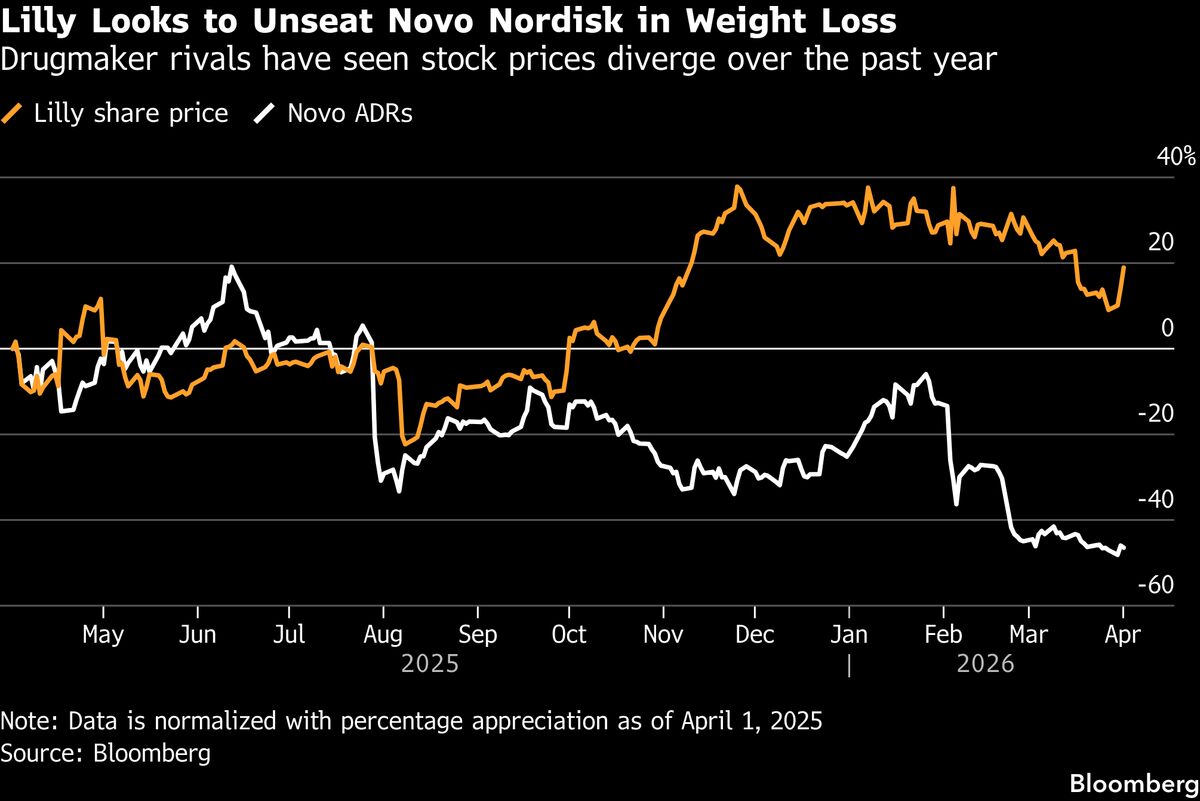
FDA approval of Lilly’s weight‑loss pill Foundayo marks the second approved GLP‑1 obesity drug in the US and sets up direct competition with Novo Nordisk’s Wegovy in a multibillion‑dollar market. The development accompanies a flurry of industry M&A: Eli Lilly paid $7.8B for Centessa, Biogen is acquiring Apellis for $5.6B, and Novartis agreed to pay up to $2B for Excellergy, underscoring strategic moves to diversify into high-growth therapeutic areas.
The market is transitioning from a narrow specialist-prescribed therapy to a broader primary-care addressable market, which will magnify demand volatility and shorten the time to peak prescription volumes. Expect a front-loaded surge in capacity needs for peptide/chemical API, formulation and packaging over the next 6–18 months, followed by a multi-year shift in pricing power from originators to scale manufacturers and PBMs.
Competitive dynamics will favor diversified, cash-rich pharmas that can (a) vertically integrate shortages through M&A, (b) move fast on co-formulation/line extensions, and (c) absorb margin compression via scale. Smaller specialty players will face two second-order headwinds: step-therapy by large payers that pushes patients to lower-cost oral agents, and concentrated CMO suppliers extracting premium pricing during supply stress.
Key catalysts and risks span timelines: days–weeks for launch metrics and inventory signals from wholesalers; 3–12 months for formulary decisions and step edits from top national PBMs; 12–36 months for cardiovascular/long-term safety readouts that could reset coverage and labeling. Tail risks that would reverse the optimism include class-level safety signals, abrupt payer carve-outs (e.g., Medicare non-coverage), or a rapid scaling of low-cost generics/peptide mimetics that compress gross margins by >300–500bps within 2–4 years.
For BIIB and NVS specifically, the play is optionality: BIIB’s valuation is more sensitive to successful tuck-ins and pipeline re-rating in the next 9–18 months, while NVS’s diversified balance sheet makes it a defensive acquirer that can pick up assets at trough multiples if supply dislocations persist. Both benefit indirectly from higher-priced service providers (CMOs, analytical labs) over the near term, but ultimate upside depends on payer remodeling of chronic-use pathways.
AI-powered research, real-time alerts, and portfolio analytics for institutional investors.
Request DemoOverall Sentiment
strongly positive
Sentiment Score
0.70
Ticker Sentiment
