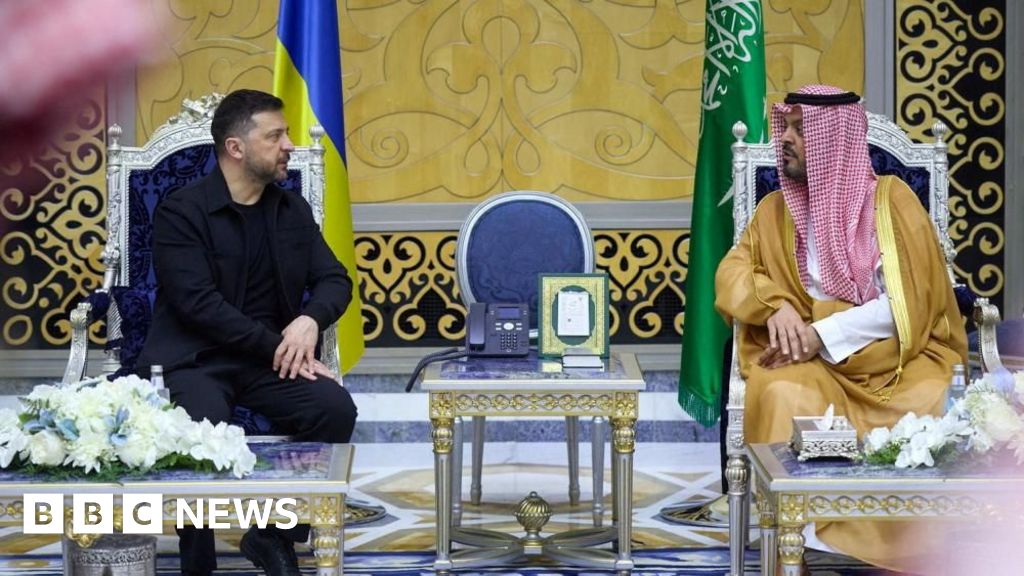
Zelensky visited Saudi Arabia to offer Ukrainian drone expertise to Gulf states while seeking air-defence missiles to bolster Ukraine's defence against Russia; several Gulf countries have approached Ukrainian drone firms but exports await Kyiv's approval. Reports that the U.S. may divert weapons from Ukraine to the Middle East amid the Iran war increase strategic urgency for a drone/air-defence deal, making this development sector-moving for defense suppliers and potentially adding a risk premium to Gulf energy security.
A rapid pathway for Ukrainian drone and EW export to Gulf buyers would create a two-tier defense market: low-cost, combat-proven loitering munitions and C-UAS/EW kits on one side, and high-end integrated sensors, interceptors and C2 integration on the other. That bifurcation favors systems integrators who sell radar/launcher packages and treaty-compliant interceptors (multi-year procurement cycles, sticky revenue) while depressing margins for incumbents selling single-role munitions if Gulf states opt for cheaper, proven Ukrainian solutions.
Key frictions are political and logistical, not technical — export approvals, sanctions alignment and interoperability with legacy Western air-defence architectures mean meaningful revenue realizations are likely measured in quarters-to-years, not weeks. A near-term catalyst that materially changes the trajectory would be an explicit procurement contract (>$100–300m) signed by a Gulf state or a public US decision to re-route American munitions; conversely, a US embargo on Ukrainian exports or a diplomatic pivot toward funneling Western arms to the Middle East would flip incentives and compress Ukraine’s bargaining power.
Second-order market effects: lower Gulf vulnerability to strikes reduces the regional oil risk premium and should cap oil volatility, tightening spreads in energy hedges — that’s a 3–9 month macro lever. Financially, private Ukrainian vendors face binary outcomes (no approvals → delayed revenue; approvals → strategic M&A or export-driven growth), so public-market exposure should favor large primes and systems integrators that can monetize long replacement cycles and integration contracts regardless of which tactical supplier wins.
The consensus underestimates the political lag; markets are pricing quick monetization of Ukrainian tech while ignoring export-control timelines and US strategic priorities. That makes for asymmetric trades that target the winners of protracted procurement (primes, radar/interceptor makers) and tactical oil/volatility plays rather than speculative long bets on early-stage suppliers whose deals can be vetoed at the state level.
AI-powered research, real-time alerts, and portfolio analytics for institutional investors.
Request DemoOverall Sentiment
neutral
Sentiment Score
0.05
