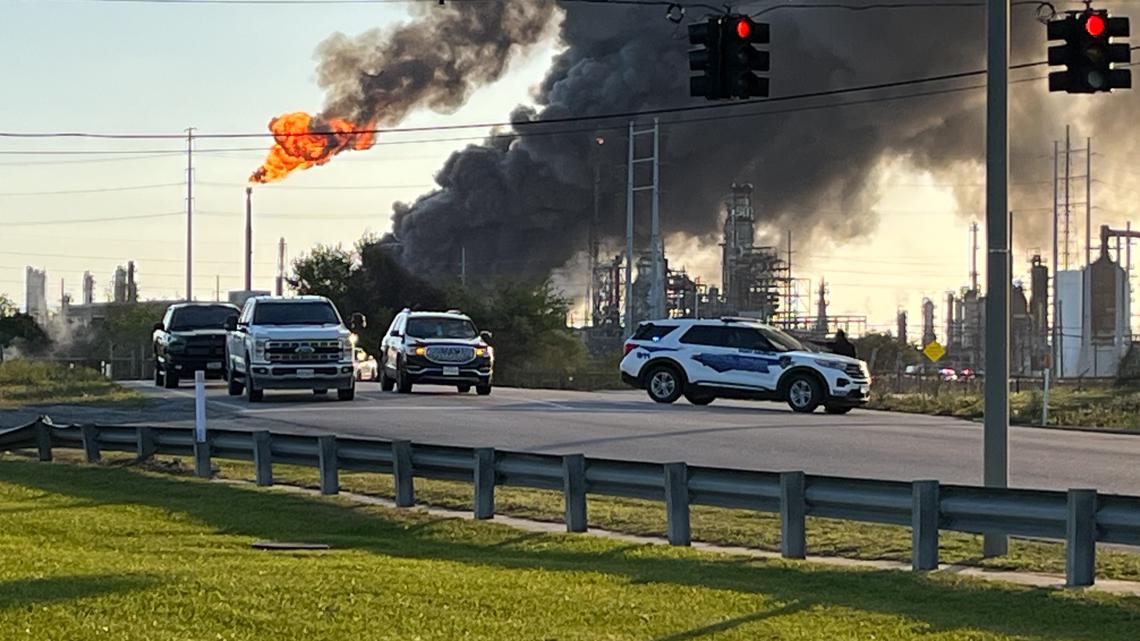
An explosion and fire at Valero’s Port Arthur, Texas refinery prompted shelter-in-place orders for west Port Arthur (Stilwell West to south of Highway 73), closure of SH 82 and SH 87, and deployment of Valero emergency responders and a hazmat team; Sabine Pass ISD closed March 23 and some buses were unable to pass road closures. No injuries have been reported and all personnel are accounted for; TCEQ and local authorities are conducting handheld and mobile air monitoring. Monitor Valero for operational updates and any confirmed production outages — likely to cause local/regional distribution and logistics disruption but limited immediate market-wide impact.
The immediate market impulse is a regional refining shock to PADD 3 product balances: a single large Gulf Coast outage can remove O(50k–200k) bbl/day of refined product availability, which historically moves regional gasoline and diesel crack spreads by $1–4/bbl over days-to-weeks. That spread move is not linear — distribution bottlenecks (barge/terminal constraints and road closures) amplify retail and industrial fuel scarcity locally, creating outsized margin capture for refiners with direct marine and pipeline access.
A second-order effect is elevated maintenance and regulatory risk across the Gulf complex. Localized incidents often trigger broad inspections and precautionary shut-ins that extend effective downtime beyond the single unit failure window; expect incremental planned outages and slower restarts over the next 4–12 weeks, not just days. Petrochemical feedstock flows (naphtha/propane) and marine bunker availability are the likely knock-on stress points, pressuring nearby chemical names and bunker suppliers before crude markets move materially.
Tail outcomes diverge sharply by timeframe. Over the next 3–7 trading days, the market will price a tactical supply squeeze; the more consequential scenario over 1–3 months is a regulatory/insurance-driven elevation in maintenance cadence that sustains higher regional crack spreads. Reversal catalysts: confirmed rapid restart, large imports into USGC, or federal/local coordination to prioritize product flows; escalation catalysts: equipment loss requiring weeks of repairs or multi-site inspections prompting rolling outages.
Trading should be asymmetric: buy optionality to capture quick crack widening and take concentrated, hedged exposure to Gulf-integrated refiners that can export or reroute barrels. Avoid naked exposure to smaller, inland refiners or chemical producers with high feedstock elasticity to regional fuel prices — they are first to see margin compression if spreads normalize quickly.
AI-powered research, real-time alerts, and portfolio analytics for institutional investors.
Request DemoOverall Sentiment
mildly negative
Sentiment Score
-0.25
