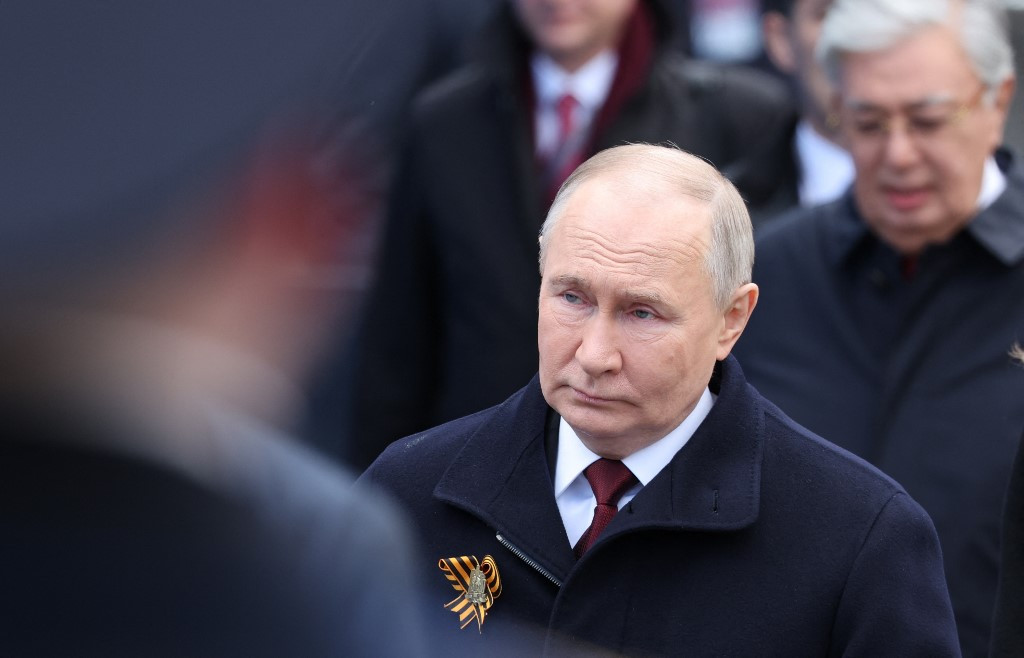
Russia warned it could launch "massive retaliatory strikes" on Kyiv, including against "decision-making centers," if Ukraine disrupts Victory Day events in Moscow. Moscow also urged foreign diplomatic missions to evacuate staff and citizens from Kyiv, while scaling back its May 9 parade and imposing intermittent mobile internet shutdowns in Moscow. The escalation raises near-term geopolitical and military risk across the region and could drive risk-off sentiment in broader markets.
This is less about imminent escalation and more about signaling under stress: Moscow is trying to deter a symbolic disruption while implicitly advertising that its air-defense and internal security posture is brittle. The market-relevant second-order effect is not a broad war-risk repricing, but a spike in the probability of short-lived, high-variance headlines around Kyiv, Moscow, and Black Sea logistics over the next 3-7 days. That favors optionality over outright directional exposure because the main asset-price reaction will likely be intraday and mean-reverting unless an attack produces visible damage on May 9 itself.
The clearest beneficiaries are defense and counter-UAS supply chains, but not uniformly. Names with exposure to interceptor munitions, radar, EW, and secure comms should outperform headline defense primes because this episode highlights the gap between expensive air-defense systems and cheap drones; the marginal winner is whoever can scale low-cost detection and defeat. A prolonged internet blackout in Moscow also reinforces the value of resilient civilian infrastructure and satellite/comms redundancy, which is a subtle tailwind for cyber, secure networking, and satellite operators tied to sovereign resilience.
The key risk is that rhetoric becomes action if either side misreads the other’s red lines. A successful strike on Moscow would likely trigger a fast but targeted retaliation cycle, with increased tail risk for European gas, sovereign spreads in Eastern Europe, and any assets sensitive to sanctions escalation. Conversely, if the parade passes without incident and the ceasefire theater collapses into a damp squib, the premium in war-sensitive assets should bleed out quickly over 1-2 weeks.
Consensus is probably over-weighting the headline and under-weighting regime durability. The bigger medium-term signal is that Russia is telegraphing constraints: it needs domestic spectacle, censors the information environment, and leans on diplomatic theater to compensate for defense gaps. That makes this a confidence problem for Moscow, not yet a fundamental regime-change catalyst, so the trade should be tactical rather than structural unless the event meaningfully punctures the Kremlin’s propaganda narrative.
AI-powered research, real-time alerts, and portfolio analytics for institutional investors.
Request DemoOverall Sentiment
strongly negative
Sentiment Score
-0.55
