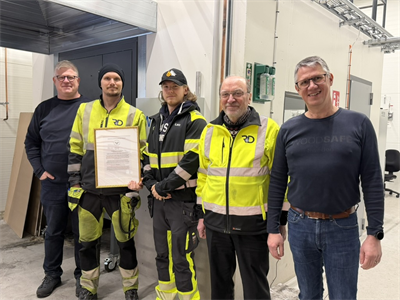
Woodsafe Research & Development AB has received ISO/IEC 17025 accreditation from Swedac, making it the only privately owned laboratory in its niche accredited for fire testing of wood-based materials. The accreditation provides internationally recognized traceability and quality assurance for reaction-to-fire testing, bolstering WRD's role as an independent technical resource for product development, verification and regulatory compliance amid tightening rules for wooden facades in construction.
Market structure: The WRD ISO/IEC 17025 accreditation tightens the verification layer for façade/fire tests and benefits accredited labs and vertically integrated timber producers who can internalize compliance (expect relative win for NYSE:LPX, NYSE:BCC, NYSE:WY). Smaller treatment suppliers and unaccredited test houses lose pricing power and face higher gate costs; I estimate incumbent timber producers could capture a 2–5% share shift in engineered-wood façade projects within 12–24 months, supporting modest price power and margin expansion. Lumber futures and engineered-wood demand should see upward pressure (lumber +5–10% scenario over 6–18 months if codes accelerate adoption).
Risk assessment: Tail risks include a high-profile post-installation fire or adverse study that prompts regulators to tighten or rollback wood façade approvals (a 20–50% demand shock in affected segments within quarters). Immediate market impact is minimal (days); crystallization window is short-term (3–9 months) as building codes and insurers react; longer-term (1–3 years) depends on insurance acceptance and harmonized EU/Swedish code changes. Hidden dependency: uptake hinges on insurer acceptance — if major insurers require ISO-traceable testing, adoption accelerates; absent that, accreditation is necessary but not sufficient.
Trade implications: Direct plays—establish a 2–3% portfolio long split between LPX and BCC (target 12–18% upside over 12 months, stop-loss 8%). Pair trade—long LPX vs short VMC (Vulcan Materials, VMC) 1–2% to play wood substitution vs heavy materials for cladding projects over 6–12 months. Options—buy 6–9 month call spreads on LPX (buy ATM, sell 20% OTM) size 0.5–1% to cap cost; hedge with 6–9 month 10% OTM puts (0.5%) to protect regulatory tail risk.
Contrarian angles: Consensus may overestimate speed of penetration—procurement cycles and insurer/code acceptance often lag 6–18 months, so near-term revenue upside for wood producers is underdone while testing labs see earlier demand. Historical parallels (flame-retardant and structural-accreditation shifts) show incumbents capture share but project pipelines slow; unintended consequence: higher testing standards raise barriers and temporarily suppress project starts by ~10–20% over 6–12 months. Implement small downside hedges (1–2% portfolio puts on LPX/BCC) until EU/Swedish code language and insurer bulletins are confirmed in the next 3–9 months.
AI-powered research, real-time alerts, and portfolio analytics for institutional investors.
Request DemoOverall Sentiment
mildly positive
Sentiment Score
0.30
