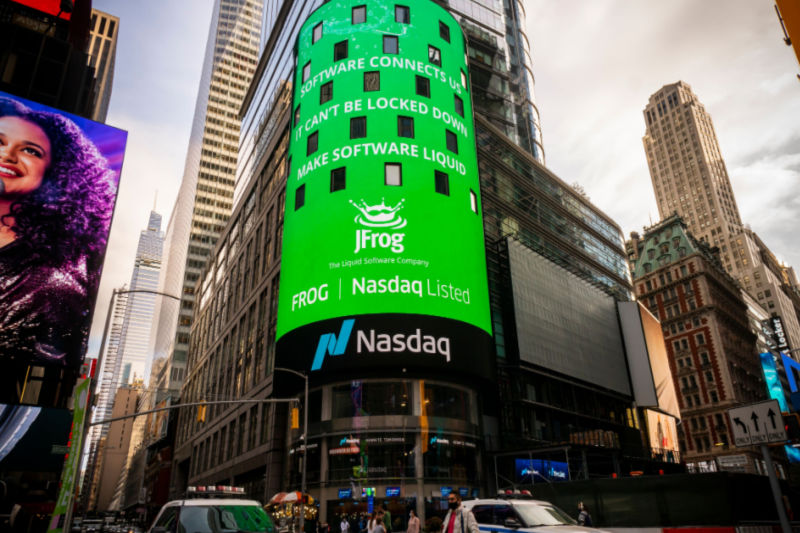
Revenue grew 24% YoY to $532M with a 77% gross margin. Multiple analysts are bullish (Truist reiterated Buy, $70 PT; UBS upgraded to Buy, $60 PT; TD Cowen and Guggenheim reiterating Buys with $80 and $60 PTs) while shares trade near $45.57 and analysts expect profitability this year. Recent open-source supply-chain attacks and AI-driven threat concerns, plus JFrog's launch of an Agent Skills Registry integrated with NVIDIA, are likely to boost demand for its Curation and Xray security products.
JFrog is positioned at the intersection of developer workflows and enterprise policy enforcement, which gives it the potential to act as a choke point for package-level controls that enterprise security teams lack today. That positioning creates optionality: a short-term spike in spending after high-profile supply-chain incidents, and a multi-year recurring-revenue expansion if customers accept upstream gating as part of CI/CD.
The time profile matters: expect event-driven procurement in days–weeks for emergency scanning/lockdown, but durable enterprise contract wins and meaningful ARR expansion will likely play out over 6–24 months because of procurement, integration and developer adoption cycles. Key negative reversals are actionable and fast — integration of equivalent capabilities by hyperscalers or major CI providers, or visible developer productivity losses from false-positives, would materially compress expansion multiples.
Consensus appears to treat new attacks as a binary catalyst that will automatically re-rate vendors; the missing piece is adoption friction and competitive bundling. If enterprises demand lightweight, low-friction enforcement (policy as code, transparent SBOMs), vendors that can insert with minimal dev-visible latency win; those that introduce gating will face longer sales cycles and higher churn. That dichotomy argues for size-scaled, risk-defined exposure rather than concentrated directional bets, and for monitoring regulator activity (SBOM mandates) and hyperscaler product roadmaps as principal catalysts/risks over the next 12–24 months.
AI-powered research, real-time alerts, and portfolio analytics for institutional investors.
Overall Sentiment
moderately positive
Sentiment Score
0.60
Ticker Sentiment
