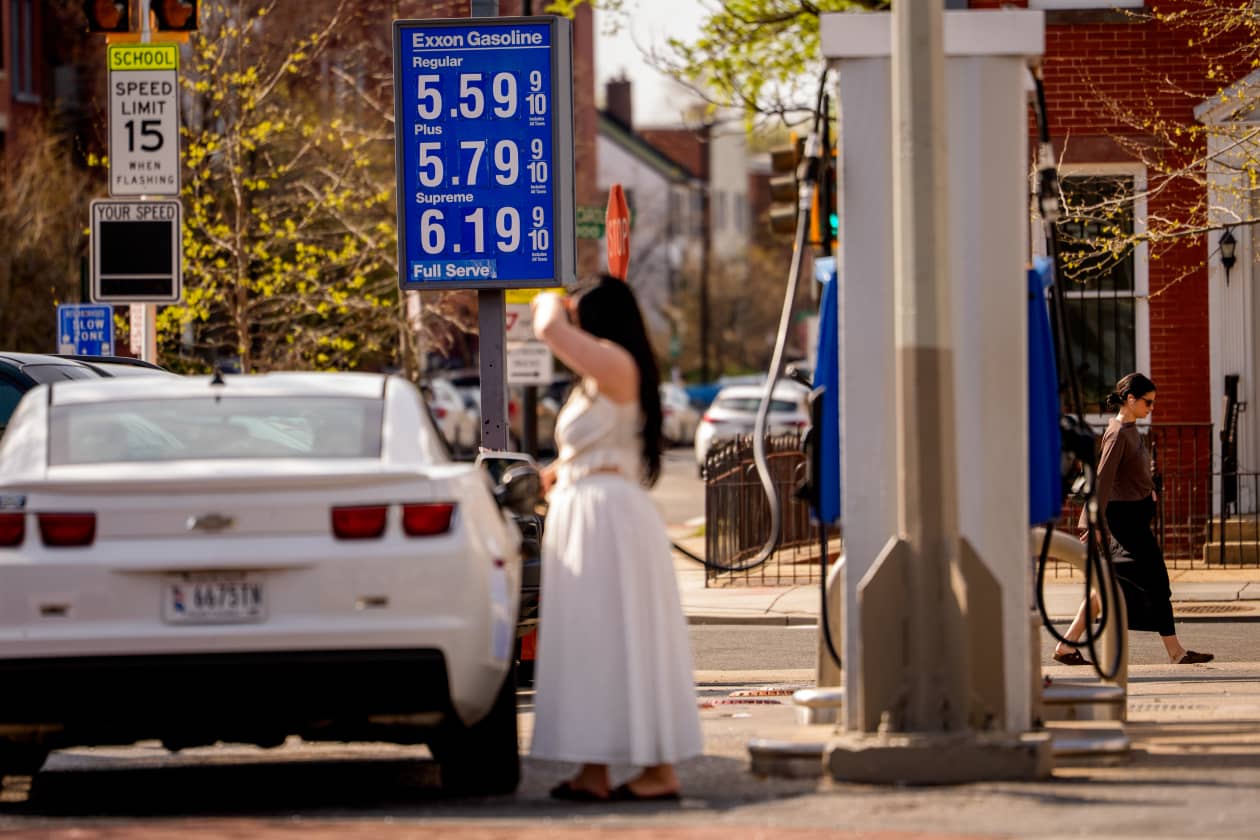
The national average gasoline price has topped $4/gal and roughly 20% of global oil supply transits the Strait of Hormuz, which Iran has effectively closed amid the war that began in late February. Higher oil prices are eroding consumer sentiment and spending, and the resulting market volatility — including a falling stock market — could inflict larger indirect damage on the U.S. economy than pump prices alone.
The immediate market reaction understates the asymmetric second-order channel: higher oil acts like a targeted tax on mobility and logistics that compounds through retail margins, food CPI and freight-sensitive inventory restocking. Empirically a sustained ~$10/bbl move in crude translates to roughly a $0.25–0.35/gal pump move within 6–8 weeks and typically subtracts 0.5–1.5% from discretionary spending in the following quarter as households reallocate.
Winners are not just upstream producers but owners of short-cycle output and mothballed capacity that can be ramped quickly; losers include low-margin retailers, regional airlines and asset-heavy transport/logistics firms whose contracts reprice with lag. Expect margin divergence: energy producers capture near-term incremental cash flow while midstream/refiners face volatile crack spreads and retailers face input-driven margin compression that shows up unevenly across the next two earnings seasons.
Tail risks cluster around geopolitical escalation and policy reaction. A kinetic widening of the conflict could push front-month oil into a $120–150/bbl scenario within weeks, forcing coordinated SPR releases or OPEC supply responses that could normalize prices inside 30–90 days. Conversely, a swift diplomatic de-escalation or meaningful SPR + commercial releases would likely trigger a 20–35% downside in front-month futures within 1–3 months, creating strong mean-reversion for energy beta.
Consensus is focused on headline pump pain but underweights balance-sheet and positioning asymmetries: corporates with flexible pricing and low leverage will outlast more leveraged, inventory-heavy players. Monitor physical indicators (floating storage, tanker flows, refinery utilization) and futures curve shape—steep backwardation validates the tightness narrative and justifies active long-energy exposure; contango signals mean-reversion and favors short-duration, volatility-oriented trades.
AI-powered research, real-time alerts, and portfolio analytics for institutional investors.
Request DemoOverall Sentiment
mildly negative
Sentiment Score
-0.35
