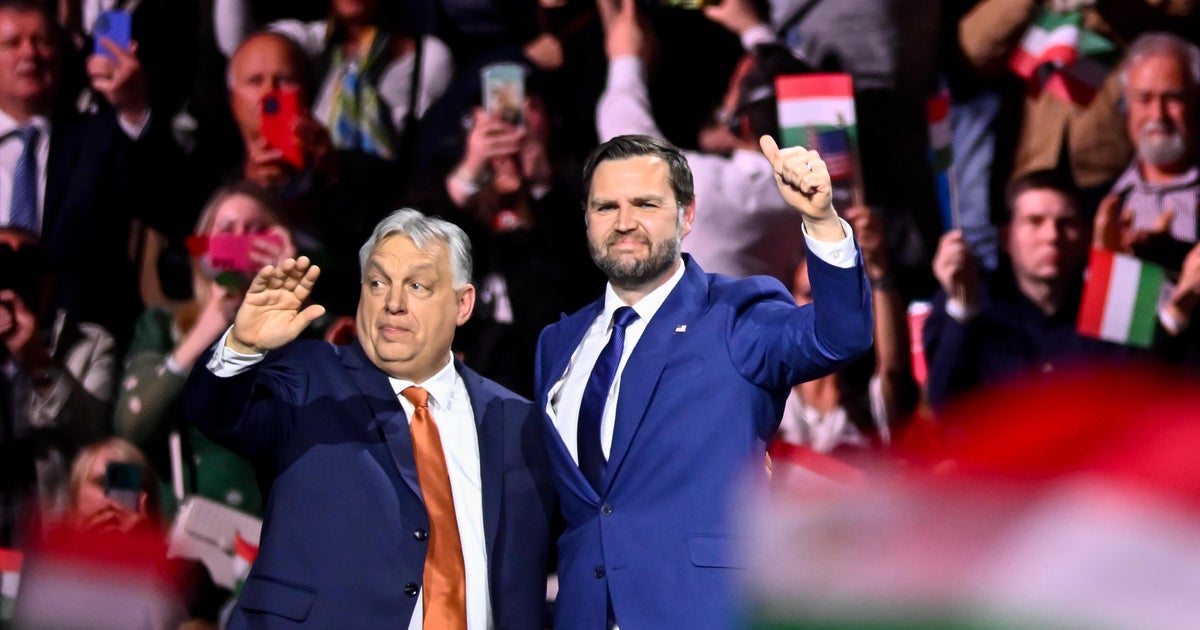
JD Vance visited Budapest to publicly campaign for Prime Minister Viktor Orbán ahead of Hungary's April 12 election and accused the EU of interfering. Most independent polls show Orbán and Fidesz running a double-digit deficit to main opponent Péter Magyar; Freedom House rates Hungary as 'partly free' and Orbán has strengthened ties with Russia. EU officials pushed back, emphasizing elections are citizens' choices and noting use of diplomatic channels; political tensions raise diplomatic and geopolitical tail risks but are unlikely to materially move markets.
The immediate market vector is political-risk-induced funding and FX stress concentrated in a small open economy with outsized external linkages. If Brussels-level conditionality or market-driven risk premia intensify, expect a rapid repricing: EUR/HUF moves of 5–15% and 5y Hungarian CDS widening 150–300bps are realistic within 1–3 months given limited domestic macro policy buffers. That path compresses credit availability for domestic corporates and raises short-term funding costs for local banks, while exporters temporarily benefit from a weaker currency.
Second-order sectoral winners and losers will be non-obvious: exporters and FX-earning corporates should see margin relief from a depreciated currency, while domestically-funded sectors (retail, real estate, construction) and banks with large unhedged HUF balance sheets will suffer asset-quality shocks. Regional banking names with big CEE footprints (Austrian/CEE banks) are likely to trade as a proxy for contagion risk — a hit to confidence in one member state lifts perceived sovereign-bank correlations across the region. Energy incumbents with discretionary access to non-EU supply channels could obtain tactical advantages if political alignment shifts procurement, but that is a high-regulatory tail risk.
Time horizons: the most acute moves happen in days-to-weeks around political shocks and in the following 3–12 months as conditionality or capital flight crystallizes. Reversals can occur quickly if (a) markets see credible fiscal backstops from EU/IMF channels, or (b) a surprise political moderation restores investor confidence. Monitor cross-asset signals (FX, 5y CDS, top-5 bank CDS) for a coordinated risk-off trigger before deploying size.
AI-powered research, real-time alerts, and portfolio analytics for institutional investors.
Request DemoOverall Sentiment
neutral
Sentiment Score
0.00
