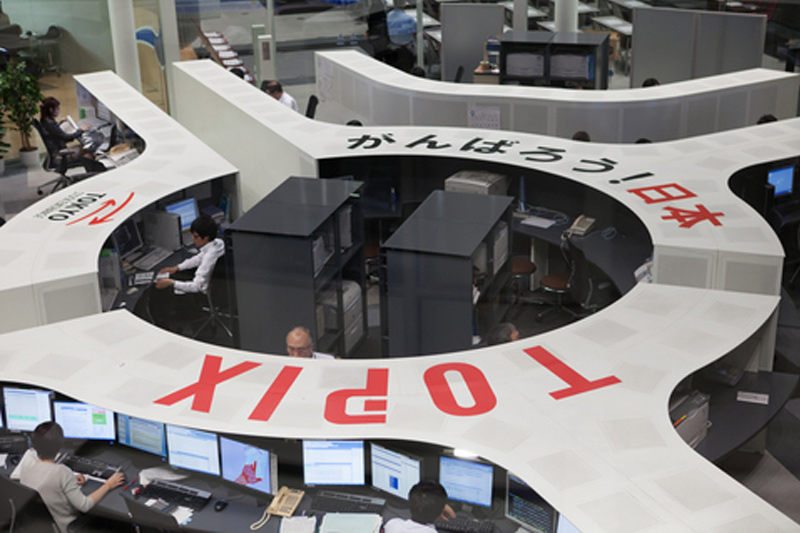
The Nikkei 225 fell 1.27% on Tuesday, with decliners (2,174) outnumbering advancers (1,392) and Nikkei implied volatility spiking 48.41% to 49.45. Top losers included Fujikura (-9.21%), Furukawa Electric (-7.00%) and Sumitomo Electric (-6.89%), while Shift (+3.42%), Teijin (+3.36%) and Recruit (+3.32%) led gains. Commodities: WTI crude for May $102.67 (-0.20%), Brent for June $106.94 (-0.42%), and June gold futures $4,587.30 (+0.65%). FX: USD/JPY 159.73 (+0.03%) and EUR/JPY 183.24 (+0.05%).
Equity derivatives and FX are the primary transmission channels today: elevated implied vol on Japan indices and a weak yen have stretched corporate sensitivities that usually remain latent. That combination creates asymmetric payoffs — large-cap exporters are getting an immediate translation boost to reported profits while domestic-facing sectors (energy importers, paper/pulp, transport) are experiencing margin compression and higher working-capital volatility over the next 1–3 quarters.
Second-order supply-chain effects matter: persistent yen weakness will pull global procurement demand forward as Japanese buyers lock in dollar-priced raw materials, amplifying near-term commodity flows and keeping input-cost tails active for manufacturers and utilities. Conversely, multi-national exporters will likely delay hedging, increasing their net FX exposure and amplifying reported EPS beat-miss volatility into reporting windows.
From a flows/derivatives perspective, the run-up in options prices creates a two-way trade: near-term premium is richly priced, but centering a horizon around 2–8 weeks captures likely mean reversion if there is any policy or FX intervention. Liquidity is thinner in spot/OTC hours around central bank windows, so executed option structures should account for wide bid-ask and gap risk — short-dated selling is attractive only if sized to survive a one-day gap move.
Tail risks and catalysts: the dominant reversal catalysts are either (1) a sudden coordinated FX intervention or liquidity injection that snaps the yen tighter in days, blowing up short-gamma positions, or (2) a sustained US rate move higher that further weakens carry-adjusted currencies and deepens equity downside over months. Time-horizon matters: expect noisy day-to-week moves from positioning and 1–3 month directional moves driven by macro rates and corporate hedging behavior.
AI-powered research, real-time alerts, and portfolio analytics for institutional investors.
Request DemoOverall Sentiment
neutral
Sentiment Score
-0.05
Ticker Sentiment
