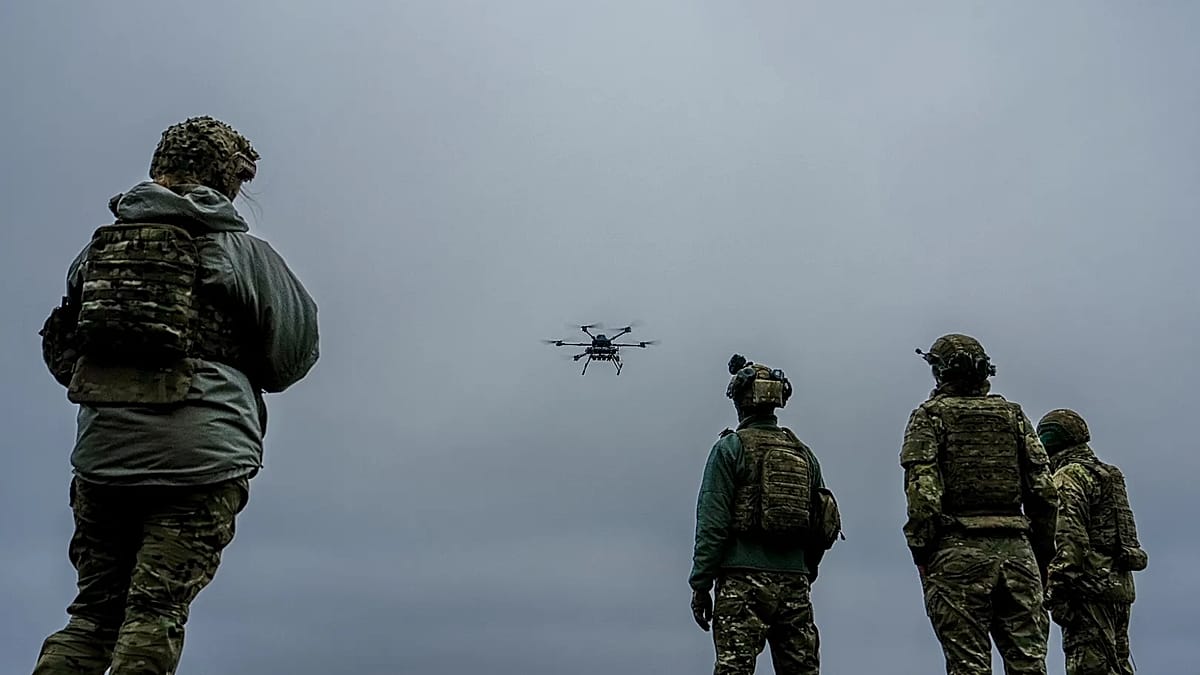
Ukraine will open 10 weapon export centres across Europe and begin production of Ukrainian drones in Germany in mid‑February, with similar production lines already in the UK; President Zelenskyy said there are about 450 drone producers in Ukraine (40–50 described as top‑tier) and that the country now produces over 4 million drones annually and could double output with sufficient funding. The announcement follows a September 2025 lift of wartime export restrictions in favour of a 'controlled export' regime to sell surplus military equipment and use proceeds to fund weapons, a move that could internationalise Ukraine’s defence supply chains and attract investment into its drone sector.
Market structure: Ukraine’s move to open 10 European export centres and scale production (article cites ~4m drones/year, potential to double) shifts pricing power toward high-volume, low-cost drone producers and European integrators that host lines. Winners: large defense primes (systems integrators) and EU-based electronics/battery suppliers who capture assembly and recurring revenue; losers: premium legacy munition vendors and any supplier dependent on scarcity pricing. Cross-asset: expect modest bid to EU defense equities and semiconductor suppliers, mild EUR support vs peers, higher industrial metals/lithium demand, and elevated options implied vol for defense names around key licensing dates.
Risks & timing: Tail risks include Russian kinetic/privateer retaliation, EU/German regulatory reversals or export-control tightening, IP disputes and technology leakage; these can cause 20-50% repricing in affected equities. Immediate (days): knee-jerk sector re-rating; short-term (weeks–3 months): P&L swings as production lines come online and first export approvals appear; long-term (6–24 months): structural surplus could compress drone ASPs and margins if global demand doesn’t scale. Hidden dependencies: semiconductor supply, battery cell availability, and explicit EU export frameworks (expect decisive language in 30–60 days).
Trade implications: Tactical overweight European/U.S. defense integrators and select suppliers—position size 1–3% per name—with re-eval at delivery milestones (mid-February production ramp). Use 6–12 month call spreads (20–30% OTM) on LMT and RHM.DE to capture convexity while limiting capex; add 1–2% exposure to lithium (ALB or LIT) and copper miners for battery/cabling demand. Avoid indiscriminate small-cap drone equities with negative cash flow; prefer balance-sheet strong names.
Contrarian angle: Market may underprice deflationary effect of massive drone supply—unit ASPs could fall 30–50% over 2–3 years if production doubles without commensurate global procurement. Historical parallel: post-conflict materiel surpluses pressured incumbents’ margins. Unintended consequence: rapid internationalisation may trigger export controls that abruptly curtail revenue flows, so scale positions into verified licensing milestones rather than announcements.
AI-powered research, real-time alerts, and portfolio analytics for institutional investors.
Request DemoOverall Sentiment
moderately positive
Sentiment Score
0.45
