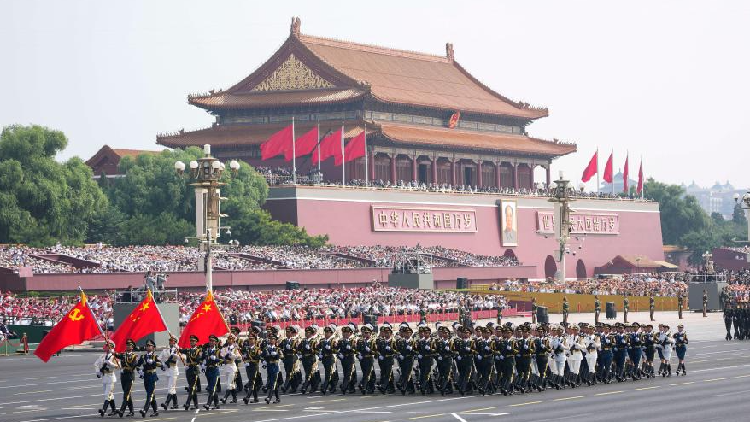
Beijing's 2025 military highlights show accelerated PLA modernization and an assertive posture: a massive Sept. 3 victory parade, commissioning of the carrier Fujian with electromagnetic catapults on Nov. 5, new branch flags and revised military rules, and major exercises including 'Strait Thunder-2025A' (April 2) and carrier training in the Western Pacific (June). Beijing also issued tighter online military-information regulations (effective March 1) and published an arms-control white paper (Nov. 27), while repatriating 30 wartime remains on Sept. 12 and noting 1,011 returns over 12 years. These developments raise regional geopolitical risk, implying potential upside for defense suppliers but a modest risk-off impulse for Asian markets and investor positioning.
Market structure: China's commissioning of an EM‑catapult carrier, regular carrier deployments and high‑tempo cross‑strait drills are demand signals for shipyards, naval avionics, sensors, munitions, composites and rare earths; expect suppliers to see a multi‑year capex cycle (2–5 years) with pricing power in specialized components (margins +100–300bps possible for niche suppliers). Losers in the near term are regional travel/tourism, Asian offshore services and any export‑dependent Chinese civilian tech suppliers that face new controls or reputational risk.
Risk assessment: Tail risks include a limited kinetic clash around Taiwan (low probability, high impact) or sweeping sanctions that freeze supply chains — either could spike Asian equity volatility >25% realized in 1–3 months and push safe‑haven rates down (US 10y -20–40bp intraday). Immediate window (days): sentiment shocks around exercises; short term (weeks–months): policy/budget moves (NPC March defense budget); long term (years): sustained regional rearmament and domestic onshoring of supply chains.
Trade implications: Favor a tactical overweight to western defense primes (LMT, RTX, NOC) and specialty materials (MP, LYC.AX) while hedging Asia EM (EEM) via 3‑month put spreads; add cybersecurity exposure (CRWD, PANW) for structural demand. Use pair trades (long RTX vs short EEM) to capture relative re‑rating and buy 3‑6 month volatility protection on Asia ETFs sized to 0.5–1% portfolio.
Contrarian angles: The market underestimates the bifurcation: Western defense contractors can outgrow weak EM markets but pricing for commoditized steel/shipbuilding may compress if China scales sovereign production. Historical parallel: 2014–18 Asia tensions led to 15–30% outperformance of US primes vs EM; if China’s defense budget growth exceeds +5% yoy at NPC, re‑rate acceleration is likely and is a buy trigger.
AI-powered research, real-time alerts, and portfolio analytics for institutional investors.
Request DemoOverall Sentiment
moderately negative
Sentiment Score
-0.30
