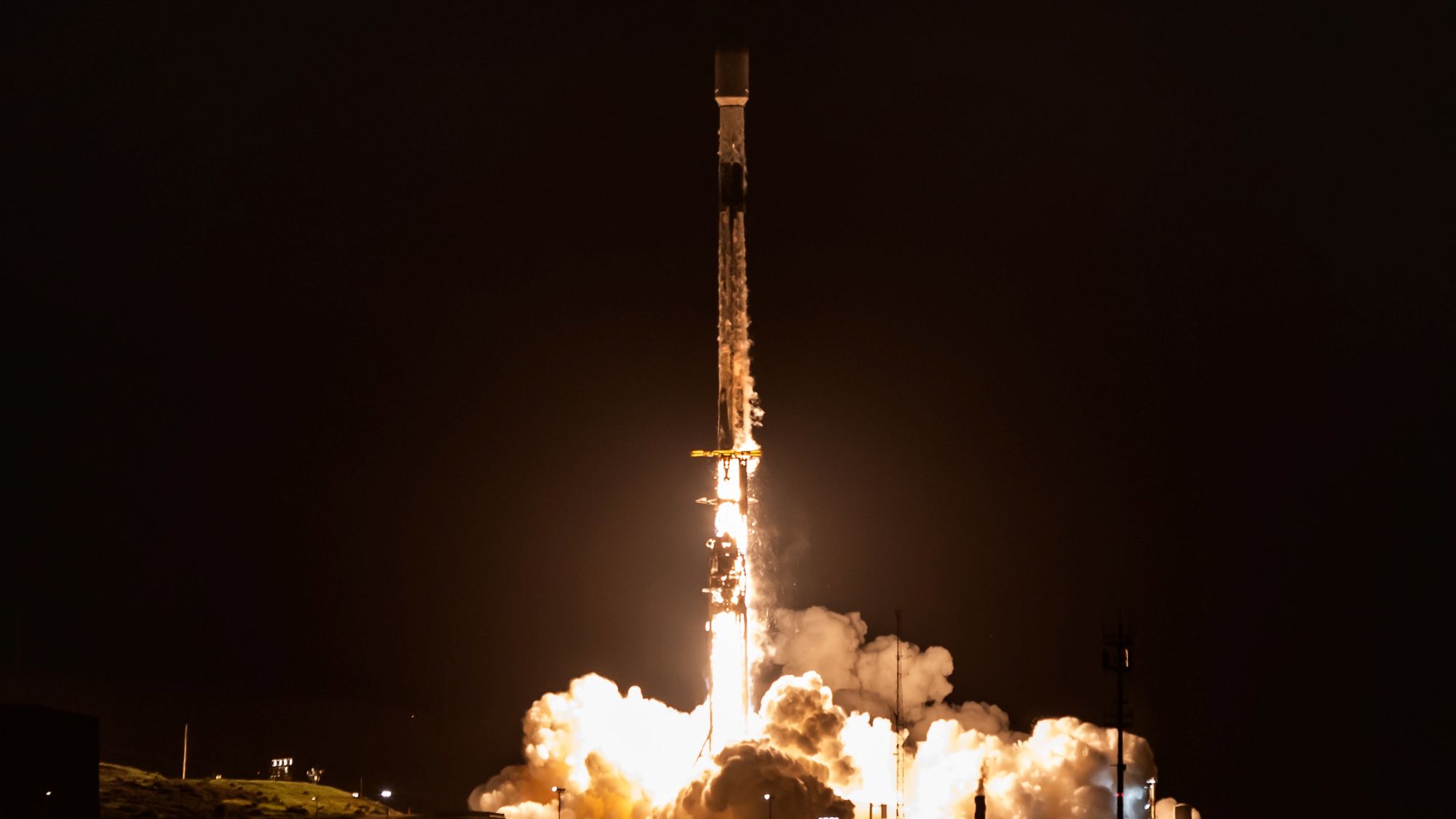
A Falcon 9 launched 27 Starlink satellites from Vandenberg Space Force Base at 12:28 a.m. ET on Dec. 2, marking SpaceX's 60th launch from California this year; the first stage (booster B1081) landed on the droneship 'Of Course I Still Love You' on its 20th mission and the upper stage deployed the payload ~62 minutes after liftoff. The flight underscores SpaceX's high operational cadence—94 Falcon 9 missions from Florida and five Starship suborbital tests from Texas in 2025—and the continued rapid expansion of the Starlink constellation (now over 9,000 spacecraft), reinforcing the company's scale advantages and execution reliability for stakeholders tracking capacity, reuse economics and competitive positioning.
Market structure: SpaceX’s blistering cadence (60 CA + 94 FL launches YTD) further entrenches its cost curve advantage via reuse (booster B1081 on 20th flight) and increases Starlink capacity against incumbents. Winners are companies tied to high-volume LEO demand (satellite component suppliers, radar/ground-station integrators); losers are small/early-stage launchers and consumer VSAT incumbents facing price competition. Expect downward pressure on per-launch ASPs for rides and smallsat/SSO missions (20–40% price compression risk over 12–24 months) as capacity outstrips marginal demand for bespoke launches.
Risk assessment: Tail risks include major orbital collision, a high-profile launch failure grounding Falcon 9 or Starship (day-to-month impact on launch supply), and regulatory pushback on spectrum/astronomical impacts (6–18 months). Hidden dependencies: SpaceX’s private balance sheet and cross-subsidization of Starlink mean public peers’ financials understate competitive intensity; semiconductor and composite supply bottlenecks could reintroduce cost pressure. Key catalysts: FCC/NTIA rulings, a DoD procurement cycle (next 3–12 months), and any Starlink monetization disclosures.
Trade implications: Direct plays favor large defense primes/ground infrastructure suppliers (RTX, LMT, MAXR) and short capital-hungry small launchers (RKLB) and consumer-focused satellite broadband (VSAT). Options: buy puts on RKLB and VSAT 3–12 month expiries; buy calls or sell covered calls on RTX/LMT sized 1–3% of portfolio to capture stable government cashflows. Pair trade: long LMT vs short RKLB to arbitrage government-prime resilience vs commercial launch commoditization.
Contrarian angles: Consensus underestimates supplier winners — firms that produce antennas, RF filters, launch integration hardware will see order growth even as launch pricing drops; consider selective longs (MAXR, a ground-ops integrator) rather than blanket satellite shorts. The market may be overpricing existential risk to incumbents; if SpaceX has an operational hiccup, small launchers could reprice up quickly (short RKLB should be hedged). Historical parallel: container shipping overcapacity cycles — durable winners are low-cost integrators, not marginal carriers.
AI-powered research, real-time alerts, and portfolio analytics for institutional investors.
Request DemoOverall Sentiment
mildly positive
Sentiment Score
0.30
