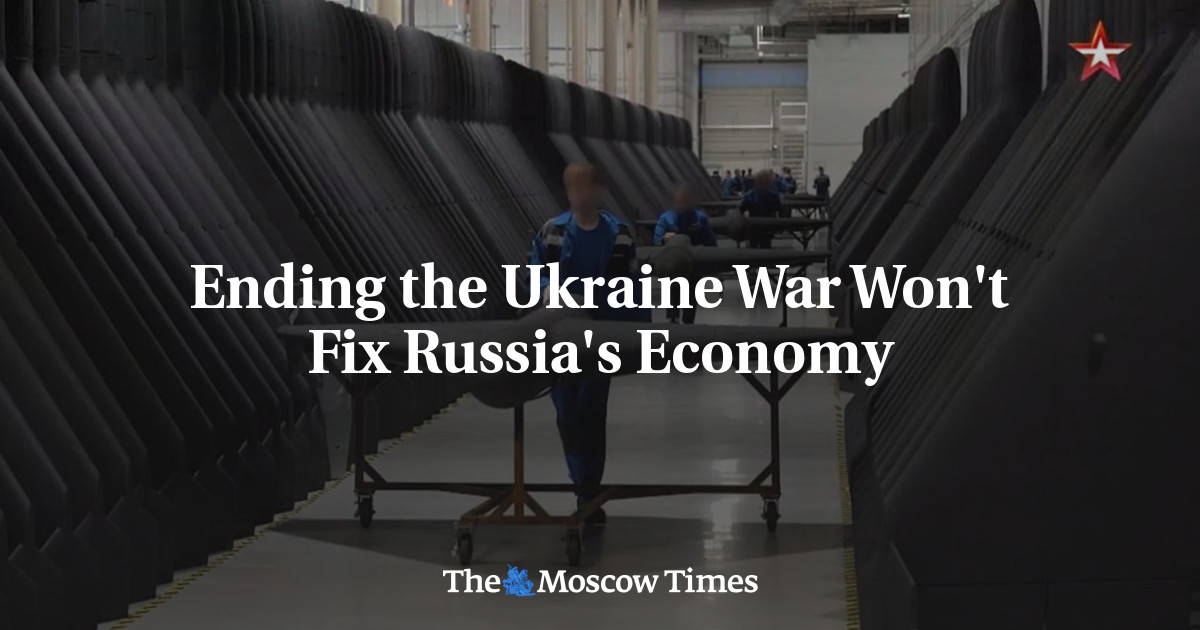
The article argues Russia's economy is being structurally reshaped by war, with defense spending at 6.3% of GDP on the official budget and more than 7% including related outlays, while the daily war cost is estimated at 36-37 billion rubles ($479-492 million). It says nationalization, labor losses, demographic damage, and dependence on China will persist even after a ceasefire, meaning peace alone would not restore normal economic conditions. The author warns that without political and institutional reform, Russia risks locking in a mobilized, militarized economy with weak long-term growth prospects.
The investable takeaway is not a clean postwar normalization trade; it is a regime-quality problem. Even if kinetic risk fades, the economy’s binding constraints shift from war finance to trust, labor scarcity, and capital misallocation, which means the marginal improvement from a ceasefire is front-loaded while the drag from institutional decay is multi-year. Markets that price a rapid rebound in Russian domestic demand, industrial output, or consumer credit would likely be extrapolating a cyclical shock that is actually structural.
The second-order implication is that the “peace dividend” could be smaller than consensus expects, while state-directed winners stay protected. Defense-linked employment, procurement, and regional transfer channels have become an absorption mechanism for slack labor and household income; unwinding that too quickly would raise social instability. That makes the political incentive to preserve a mobilized fiscal stance stronger than the economic incentive to reallocate toward productivity, so any recovery in civilian capex is likely to lag a ceasefire by several budget cycles.
Externally, dependence on China is becoming less a trade link than a balance-sheet constraint. The discount-for-inflated-inputs dynamic means Russia is swapping commodity optionality for supplier lock-in, which degrades medium-term bargaining power and raises vulnerability to sanctions on components, machine tools, and electronics. For global supply chains, the bigger read-through is that “localization” under coercion usually lowers quality and raises hidden inflation, which matters for industrial margins across Eurasia.
Contrarian view: the market may underappreciate the durability of wartime labor-market support. If military spending is cut abruptly, inflation could initially fall but unemployment and regional stress could spike, giving policymakers an incentive to keep fiscal drag more persistent than bulls expect. So the key trade is not on immediate peace, but on whether postwar policy sequencing actually restores private-sector trust; absent that, any rally in Russian risk assets should be treated as a tactical relief move, not a secular re-rating.
AI-powered research, real-time alerts, and portfolio analytics for institutional investors.
Request TrialOverall Sentiment
strongly negative
Sentiment Score
-0.65
