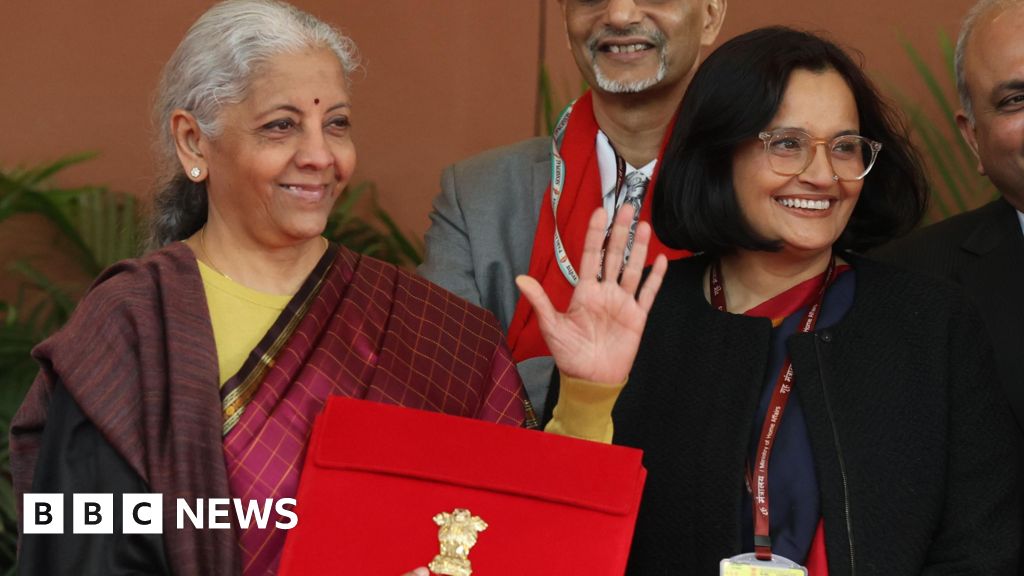
India's 2026-27 budget raises capital spending ~9% to 12.2tn rupees (≈$133.1bn) and boosts defence outlays by over 20%, while shifting fiscal policy to a debt-to-GDP target (aiming to cut from 56% to ~50% by 2030-31) and trimming the fiscal deficit from 4.4% to 4.3% of GDP. The plan pushes domestic manufacturing in strategic areas — rare earth corridors in four states following a 73bn-rupee scheme, a $436m second semiconductor mission, and a tax holiday to 2047 to spur foreign data-centre investment — but trade headwinds (US tariffs) and a higher securities transaction tax on futures/options triggered a market sell-off, tempering near-term investor sentiment.
Market structure: The budget crystalizes winners — global cloud/data-centre operators (GOOGL/GOOG), domestic infra contractors, semiconductor equipment/material suppliers, and rare-earth / battery-input processors — who gain multi-year demand visibility from a 2047 tax holiday, $436m semiconductor mission and dedicated rare-earth corridors. Losers are export-dependent small/mid caps (textiles/seafood) facing Trump's 50% tariff shock and trading/arbitrage desks that will face higher STT and likely 10–30% lower derivative volumes.
Risk assessment: Near-term risk is liquidity/volatility compression in Indian derivatives (days–weeks) and an earnings hit to exporters as tariffs phase in over 3–12 months; long-term risks (1–5 years) include execution failure on rare-earth processing, environmental permitting delays, and potential US/third‑country retaliation. Hidden dependencies: data-centre scaling requires reliable power/land and transmission upgrades (bottleneck risk), and rare-earth gains depend on downstream refining capacity, not just mining.
Trade implications: Tactical winners include GOOGL/GOOG exposure to India-hosted cloud demand and INDA/India infra exposure to capture 12.2tn rupee capex; defensive moves include trimming export-facing small-cap exposure and shifting trading flow away from futures. Options and structured instruments should be preferred over high-turnover futures in India given higher STT; use long-dated call spreads to cap premium outlay.
Contrarian angles: The market overreacted to the STT hike (derivative volume hit) but likely underprices the 20%+ uplift in defence and 9% capex increase as a multi-year GDP multiplier; rare-earth policy mirrors China’s initial industrial strategy — domestic processing could flip global pricing power if India executes, but timelines are 24–60 months, not immediate.
AI-powered research, real-time alerts, and portfolio analytics for institutional investors.
Request DemoOverall Sentiment
neutral
Sentiment Score
-0.05
Ticker Sentiment
