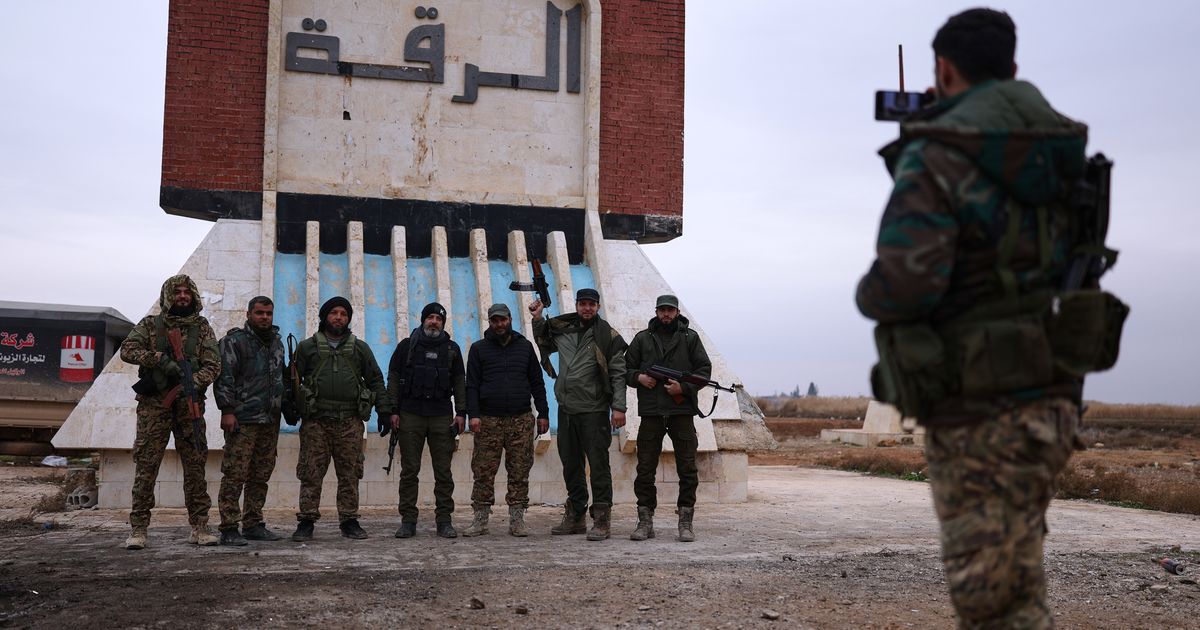
Syrian government forces seized the strategic town of Tabqa in Raqqa province, which hosts a dam controlling downstream flows and a military air base, marking a deeper push east of the Euphrates amid renewed clashes with U.S.-backed Syrian Democratic Forces (SDF). The escalation follows deadly Aleppo fighting that left 23 dead, prompted SDF withdrawals east of the river, and coincides with tensions around oil and gas assets in Deir el-Zour—raising localized risks to energy infrastructure and regional stability while leaving broader market impacts limited but increasing geopolitical risk premia for nearby energy and security exposures.
Market structure: The Syrian government push into Tabqa and Deir el-Zour raises a localized supply-risk premium for light/condensate flows tied to Al-Omar/Conoco fields and transit routes; expect a tactical oil-price sensitivity of roughly +$2–$6/bbl on headlines that confirm regional production disruption (days–weeks). Winners: large, highly liquid energy producers/ETFs (XOM, CVX, XLE), marine insurance and commodity traders; losers: regional EM sovereign debt and local oil-service contractors with concentrated exposure. Cross-asset: anticipate USD strength and EM sovereign spread widening (50–200bp), higher gold, and higher FX volatility in neighboring currencies within 48–72 hours.
Risk assessment: Tail risks include broader MENA escalation involving Iraq/Turkey or strikes on export infrastructure, which could spike Brent $10–20/bbl and trigger a 200–400bp EM spread shock (low-probability, high-impact). Immediate horizon (days): headline-driven volatility; short-term (weeks–months): intermittent output shuts and tribal seizures creating supply asymmetry; long-term (quarters–years): reallocation of control over fields could create chronic underproduction or attract reconstruction capital. Hidden dependencies: U.S. military footprints, OPEC spare capacity and emergency SPR releases are key dampeners; diplomatic moves or troop withdrawals are binary catalysts.
Trade implications: Tactical long-oil via 1–3 month call spreads or XLE call spreads sized to 0.5–3% of portfolio, with profit targets +20–30% and stop at -50% premium, is highest-conviction; add 1% exposure to defense (LMT/RTX or ITA) via 3–6 month calls as a hedge. Reduce EM sovereign and frontier-credit exposure by 20–30% (reduce EMB/ILF positions) and redeploy into 2–5 year Treasuries (IEI) or cash until volatility abates. Options: prefer defined-risk call spreads over naked calls and buy cheap tail protection (short-dated puts on EM sovereign ETFs) if contagion signals appear.
Contrarian angle: The market often overshoots initial oil risk premia—OPEC spare capacity + US SPR releases historically cap spikes within 2–8 weeks—so be ready to trim energy longs if Brent >$5 move is not matched by confirmed shut reports. Consider mean-reversion shorts (short Brent or sell XLE on strength) if field-output loss is assessed below ~100kb/d after 2 weeks. Unintended consequences include accelerated reconstruction bids and defense spending that could benefit equipment suppliers for 12–36 months if control consolidates.
AI-powered research, real-time alerts, and portfolio analytics for institutional investors.
Request DemoOverall Sentiment
moderately negative
Sentiment Score
-0.32
