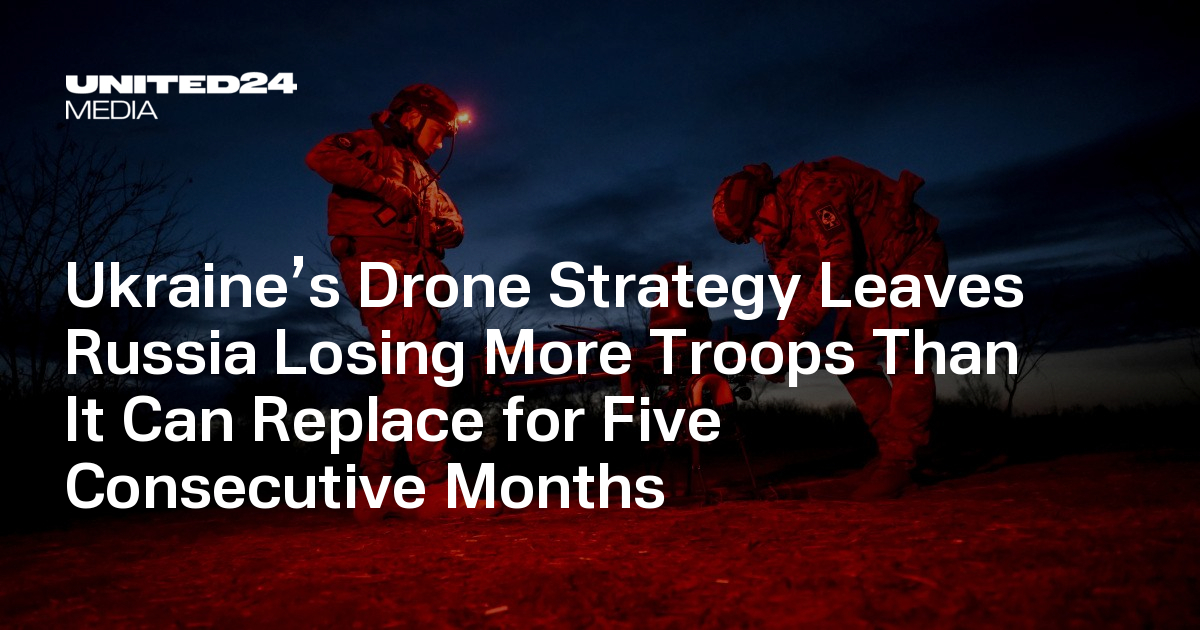
Ukraine’s drone forces say Russia has recorded a fifth straight month in which personnel losses exceeded recruitment, with 156,735 confirmed drone-related losses versus 148,400 mobilized or recruited from December 2025 to April 2026. In April alone, Ukrainian drone units struck 10,581 Russian troops, and the USF says 29.59% of its 11-month target set has been personnel. The article underscores the growing battlefield effectiveness and cost efficiency of drone warfare, but it is primarily a war update rather than a direct market catalyst.
Ukraine’s drone cadence is creating a manpower attrition loop that compounds faster than Russia can replenish, but the more important market implication is not battlefield headlines — it is the migration of war effectiveness toward cheap, scalable, software-defined systems. That shifts marginal value away from legacy heavy platforms and toward the layers that make drones survivable and effective: electronic warfare, secure comms, targeting software, thermal imaging, counter-UAS sensors, and short-cycle munitions. In other words, the winner is increasingly the ecosystem that can iterate faster, not the one that can field the most metal. The second-order effect is a procurement reset across Europe. If low-cost drones can sustain negative personnel replacement economics for months, NATO planners will accelerate spend on air defense, EW, and dispersed logistics, because the bottleneck becomes force protection rather than force projection. That favors integrators with exposure to C-UAS and battlefield networking, while pressuring prime contractors overly dependent on legacy armored vehicle or artillery volumes that can be neutralized without air superiority. The key risk is reversal through adaptation rather than brute force: better jamming, deeper air defenses, improved concealment, and faster Russian counter-drone doctrine could blunt the current kill chain over the next 1-3 quarters. A ceasefire headline would be the obvious catalyst, but the more subtle downside is budget fatigue if European governments conclude drones are “cheap enough” to substitute for larger capex plans. The contrarian view is that this is not merely a drone trade; it is a re-rating of wartime elasticity, and the current market may still be underpricing how much recurring demand this creates for consumables, sensors, and battlefield software.
AI-powered research, real-time alerts, and portfolio analytics for institutional investors.
Request DemoOverall Sentiment
mildly negative
Sentiment Score
-0.15
