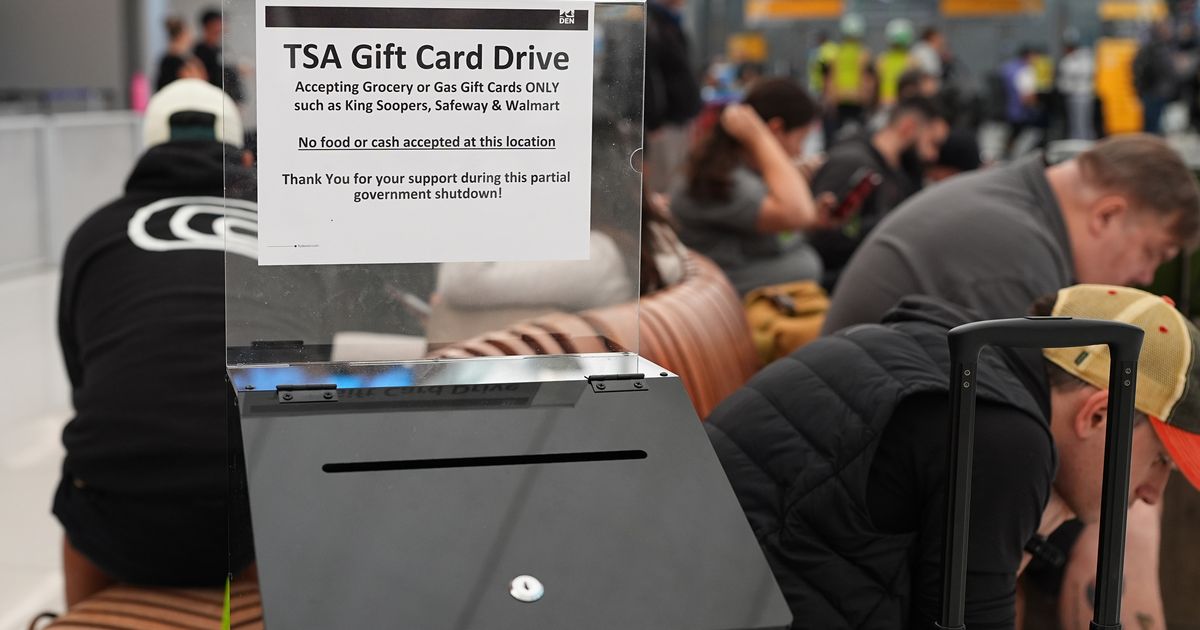
More than a month of the partial federal government shutdown has left TSA officers without full pay; nonprofits and airports are organizing relief collections while federal ethics rules limit direct gifts. Raleigh-Durham International Airport is accepting grocery and gas gift cards (but not Visa gift cards or cash) at Terminal 1 and 2 supervisor podiums and partnered with the Food Bank of Eastern North Carolina for a no-cost pantry distribution at 1101 International Drive through 2 p.m.
The direct payments impact on large consumer payments networks is economically tiny: TSA headcount (~50k) times plausible discretionary gift-card/grocery spend ($100–300/mo) implies mid-single-digit millions of dollars per month — a rounding error versus Visa’s ~$3.5T annual TPV. The larger channel to watch is behavioral and operational: persistent staffing stress at checkpoints elevates friction for air travel and ground-handoffs, which can shave airline ancillary revenues and temporarily shift some discretionary purchases from travel-related to local/online consumption.
If the shutdown persists beyond 4–8 weeks the second‑order supply effects amplify: constrained DHS components (CBP, port/security inspections) can create spot chokepoints in cross‑border freight and seasonal retail restocking, pushing short‑term logistics spot rates and inventory substitution into online grocery channels. That 1–3 month window is when logistics margin shifts matter most to retailers with in‑house fulfillment (Amazon) versus pure payment processors (Visa) that earn on volume but not on fulfillment margin.
Consensus reaction risks overstating the payments-network exposure and understating optionality in commerce platforms. The mechanical loss to Visa EPS from this event is negligible absent a broader, sustained pullback in travel/consumer spend; conversely, platforms that own fulfillment and grocery channels can capture incremental spend if workers reroute budgets to pantry stocking or ecommerce. Trade sizing should be modest and time‑bounded: this is a liquidity/operational shock, not a structural credit or network-printing event for payments rails.
AI-powered research, real-time alerts, and portfolio analytics for institutional investors.
Overall Sentiment
mildly negative
Sentiment Score
-0.25
Ticker Sentiment
