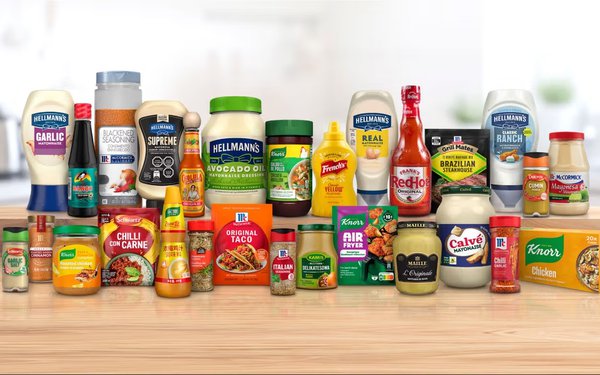
Unilever and McCormick agreed to merge into a $65 billion food company, valuing Unilever Foods at $44.8B and McCormick at $21B; Unilever will receive $15.7B cash plus 65% of the combined equity (≈$29.1B). The deal lets Unilever refocus on health & personal care while creating a scaled flavor business under the McCormick name; the transaction is expected to close mid-2027. Markets reacted coolly with shares of both down, and Unilever announced a global hiring freeze for at least three months citing the U.S.-Iran war and rising energy costs.
The transaction creates a concentrated global flavor/condiment platform that, if executed, increases pricing optionality and SKU bundling power across both retail and foodservice channels. That optionality is the real lever: combining formulation IP with global distribution lets management re-sequence SKU rationalization and private-label negotiations to lift incremental gross margin by 200–400bps over 12–36 months, not from magical top-line growth but from mix and procurement scale.
Second-order winners include specialty ingredient suppliers with scale (seasonings co-packers, natural-extract processors) who will get larger multi-year contracts but face tougher tender dynamics; losers include regional CPG packers and mid-cap multi-category food conglomerates that lack the flavor IP and will see category share erosion or margin compression as retailers push private-label. Retail customers have bargaining power to push back — expect promotional intensity and slotting negotiations to spike in the first 6–12 months after integration announcements, draining near-term EBITDA of the combined entity.
Key risks are regulatory divestiture and integration execution: an adverse antitrust carve-out or delayed approvals could shave 15–30% off the deal’s synergy runway and cause a 20%+ re-rating for the acquirer within 6–18 months. Geopolitical/energy shocks that materially raise ocean freight or spice commodity costs expose any projected margin uplift (which depends on procurement arbitrage) and create a headline sensitivity window around every sanction or spike — trade timelines should be 12–36 months with specific stop-losses tied to regulatory milestones and energy-cost indices.
AI-powered research, real-time alerts, and portfolio analytics for institutional investors.
Request DemoOverall Sentiment
mixed
Sentiment Score
0.05
Ticker Sentiment
