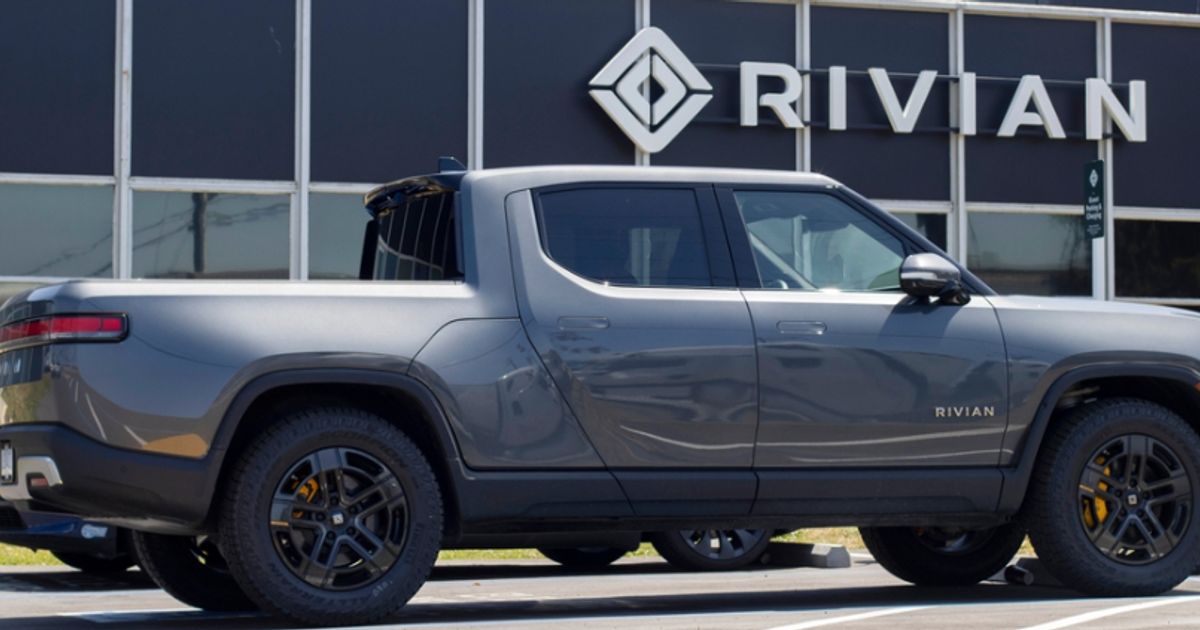
Rivian shares rallied 14.6% in after-hours trading, adding roughly $2.5bn to market value after a fourth-quarter beat: adjusted loss per share was $0.54 versus $0.68 expected and revenue was $1.29bn versus $1.26bn consensus. Full-year 2025 revenue rose 8% to $5.37bn and the company recorded its first annual gross profit of $144m (including $120m in Q4) while net loss narrowed to $3.6bn from $4.75bn. Management guided 2026 deliveries to 62,000–67,000 units (up 47%–59%), forecasted adjusted pre-tax losses of $1.8bn–$2.1bn and capex of $1.95bn–$2.05bn as it ramps production and launches the R2 in Q2.
Market structure: Rivian's beat and 47–59% 2026 delivery guidance (62k–67k units) benefits EV-focused suppliers (battery cells, Tier-1 EV components) and dealers offering R2 reservations, while pressuring loss-making pure-play EV peers that need financing. Improved unit economics (first annual gross profit $144M) increases Rivian's pricing power in mid-priced EV SUVs but still leaves large incumbents (TSLA, GM, F) as scale gatekeepers; expect margin compression for OEMs that chase aggressive discounts to defend share. Cross-asset: smaller equity raises or convertible issuance risk could widen high-yield spreads and weigh the dollar on EM-linked battery metal exporters; lithium/nickel miners (LAC, SQM) get marginally supportive demand signal.
Risk assessment: Tail risks include R2 ramp failure, a material recall, or a forced equity raise that dilutes shareholders — each could erase >30% of market cap in weeks. Near-term (days–weeks) volatility will hinge on investor reaction to liquidity commentary; short-term (months) the R2 launch (Q2 2026) is the binary catalyst for demand proof; long-term (2027+) profitability depends on hitting >150k annualized run-rate to absorb fixed costs. Hidden dependencies: Illinois plant scale-up cadence, battery supply contracts and pricing, and potential covenant triggers in debt instruments.
Trade implications: Tactical longs on RIVN are justified but size should be limited and hedged — consider 2–3% portfolio equity exposure with a $10 stop and $22–25 6–9 month target if deliveries track guidance. Use structured options to cap downside: buy Jul-26 $15/$25 call spreads (<=1% portfolio) to play upside around R2, and sell 30–45 day $10 puts (<=1% portfolio) only if comfortable owning at $10. Rotate modest capital into battery metal exposure (LAC, SQM) and reduce cyclical ICE suppliers that lag EV transition by 1–2 years.
Contrarian angles: Consensus underweights dilution risk and overweights a smooth R2 ramp — the market may be underpricing the probability of a >$1B equity raise if capex or losses exceed guidance. Historical parallels: early Tesla profitable quarters were followed by volatile re-rating despite stronger fundamentals; Rivian can repeat that path but with greater execution risk. Unintended consequence: positive sentiment could attract short-term momentum buyers leading to a sell-the-news post-R2 delivery miss; maintain tight risk controls.
AI-powered research, real-time alerts, and portfolio analytics for institutional investors.
Request DemoOverall Sentiment
moderately positive
Sentiment Score
0.45
Ticker Sentiment
