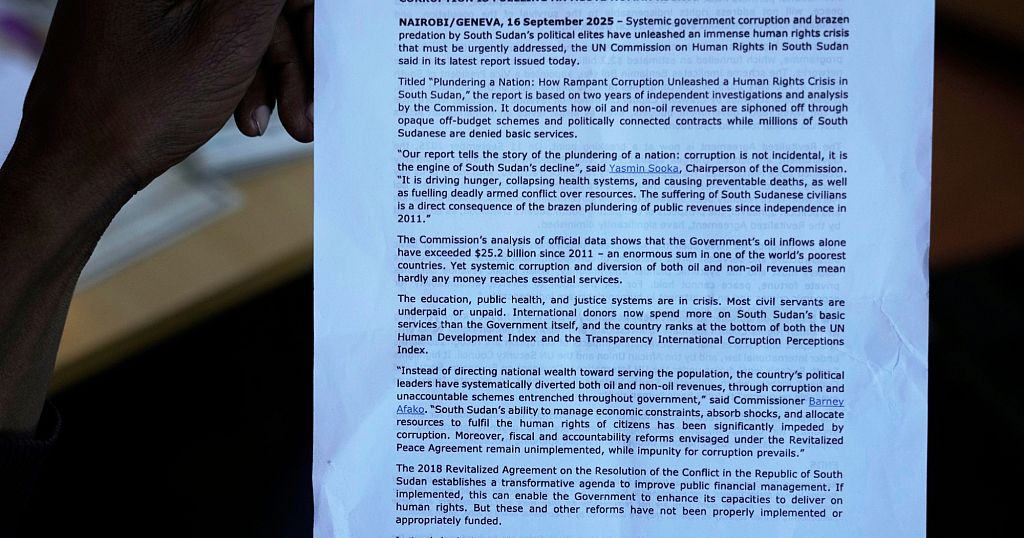
A recent UN report attributes South Sudan's severe human rights crisis and widespread hunger to systemic government corruption, alleging that political elites have diverted over $25.2 billion in oil revenues since 2011 for personal gain, notably through schemes like the 'oil-for-roads' program. Despite the government's denial of the 'absurd' allegations, this highlights profound governance failures, significant resource mismanagement, and a pervasive lack of transparency, positioning South Sudan as an exceptionally high-risk environment with critical implications for any potential capital allocation or engagement.
A United Nations report provides a damning assessment of South Sudan's governance, directly attributing the nation's severe human rights and humanitarian crises to systemic corruption within its political elite. The commission's two-year investigation alleges the diversion of substantial public revenues, with oil inflows alone exceeding $25.2 billion since 2011, being plundered rather than allocated to essential services. This resource drain is illustrated by the "oil-for-roads" program, which reportedly funneled funds to companies connected to the presidential administration. The government's failure to uphold its 2018 pledge for transparent financial management is a critical finding, reinforcing the country's bottom-tier rankings on both the UN Human Development Index and Transparency International's Corruption Perceptions Index. While the government has dismissed the allegations as "absurd," the report's findings, combined with a food crisis affecting 7.7 million people, paint a picture of catastrophic governance failure. This situation presents an extreme level of sovereign risk, characterized by a lack of accountability and the weaponization of state finances, which directly fuels conflict and social collapse.
AI-powered research, real-time alerts, and portfolio analytics for institutional investors.
Overall Sentiment
extremely negative
Sentiment Score
-0.90
