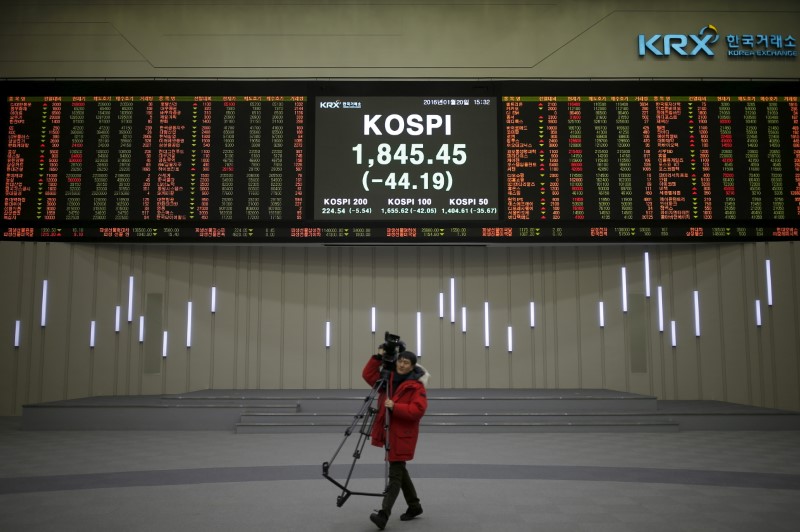
KOSPI fell as much as 3% to 5,220.10 and is set to wipe out over 8% this week; Samsung Electronics and SK Hynix slid over 4% intraday and are down more than 10% for the week. U.S. memory peers (Western Digital, Seagate, Micron) tumbled 6.9%–8.4%, with selling driven by Google’s unveiling of TurboQuant — a compression algorithm that could materially reduce AI working-memory needs and thus pressure demand for advanced memory chips — and by Arm’s new AI server chips, which sent Nvidia down >4%.
The market is re-pricing hardware TAM risk into two buckets: software-led efficiency gains that can substitute for raw DRAM capacity, and competitive diversification of inference compute away from a single vendor architecture. That creates an acute drawdown in securities tied to near-term memory ASPs and inventory sensitivity while inflating optionality for companies that own the software/IP layer that can monetize compression — a classic structural-capex vs. software-profitability rotation. Expect the initial move to be driven by positioning and quant flows over days, but fundamentals to matter on a 3–12 month cadence as vendors report server/RAID orders and capex guidance.
Key catalysts to watch with explicit timing: conference-level reproducibility (presentations → 1–3 months), hyperscaler benchmark rollouts (public cloud adoption → 3–12 months), and vendor firmware/architecture patches that either preserve or break memory savings (OEM pilots → 6–18 months). If reproducible at scale within 6–12 months, DRAM bit-demand growth forecasts could be revised down meaningfully (we model a 10–25% reduction in incremental bit growth in scenarios of wide adoption), pressuring pricing and capex. Conversely, failure modes — complexity in sparse models, latency penalties in inference, or lack of transferability across model families — would rapidly re-accelerate hardware demand and create a sharp mean-reversion in beaten-up memory/hardware names.
Competitive dynamics: software capture benefits incumbents who control the stack and hyperscaler partnerships (higher margins, recurring revenue), while ASIC/CPU entrants that can combine lower memory needs with cheaper silicon (and looser licensing) create a multi-front margin squeeze for GPU-focused vendors. That favors software/platform owners and flexible IP licensors over pure-play memory/storage OEMs in a multi-year view, but volatility will spike as market participants reweight exposure. The near-term sell-off likely overshoots on fear; a 3–6 month tradebook should separate flow-driven dislocations from structural revisions to the TAM.
AI-powered research, real-time alerts, and portfolio analytics for institutional investors.
Request DemoOverall Sentiment
mildly negative
Sentiment Score
-0.30
Ticker Sentiment
