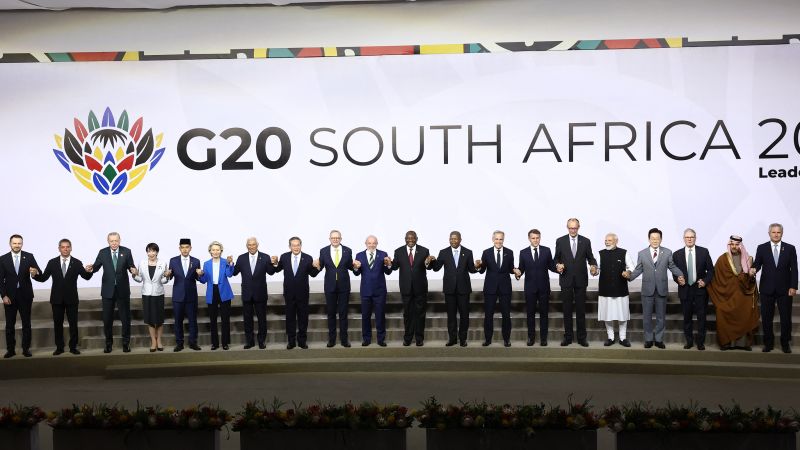
G20 leaders in Johannesburg adopted a leaders' declaration drafted without U.S. involvement that for the first time in this summit explicitly addresses climate change, praises renewable-energy targets, calls for better adaptation and flags high debt servicing burdens for poor countries—language the Trump administration had opposed—while South Africa said the text will not be renegotiated. The development underscores a widening rift with Washington, which boycotted the summit over politically charged disputes with Pretoria and whose offer to send a chargé d’affaires for the 2026 G20 handover was rejected; it also prompted warnings from EU officials about strategic dependencies such as rare-earth export controls. The outcome signals other major economies’ readiness to advance climate and developing-country priorities without U.S. backing, exposing geopolitical fractures that could complicate G20 unity ahead of the U.S. presidency in 2026.
G20 leaders in Johannesburg adopted a leaders' declaration that was drafted without U.S. involvement and explicitly references climate change, praise for ambitious renewable-energy targets, and the “punishing levels of debt service” facing poor countries; South Africa’s presidency said the text “can’t be renegotiated” and President Cyril Ramaphosa touted “overwhelming consensus,” while four sources confirmed envoys drew up the draft without the U.S. delegation. The development is a direct rebuke to the Trump administration, which opposed any climate language and publicly boycotted the summit; South Africa also rejected a U.S. offer to send a chargé d’affaires for the 2026 G20 handover, calling that a breach of protocol.
The summit exposed widening geopolitical fissures with immediate policy implications: EU Commissioner Ursula von der Leyen flagged the “weaponisation of dependencies,” an apparent reference to rare-earth export curbs, linking trade policy and critical-minerals security to the energy transition. The provided sentiment score (−0.4, “moderately negative”) and market impact score (0.36) suggest modest near-term market unease rather than systemic shock, but the combination of U.S. disengagement, sharper multilateral climate commitments and sovereign debt language increases policy dispersion risk.
For investors, the story matters for asset allocation across renewable-energy supply chains, critical-minerals miners, and vulnerable emerging-market sovereign debt; investors should anticipate policy-driven, sector-specific repricing and potential short-term volatility around G20-related developments and the 2026 U.S. presidency handover.
AI-powered research, real-time alerts, and portfolio analytics for institutional investors.
Request DemoOverall Sentiment
moderately negative
Sentiment Score
-0.40
