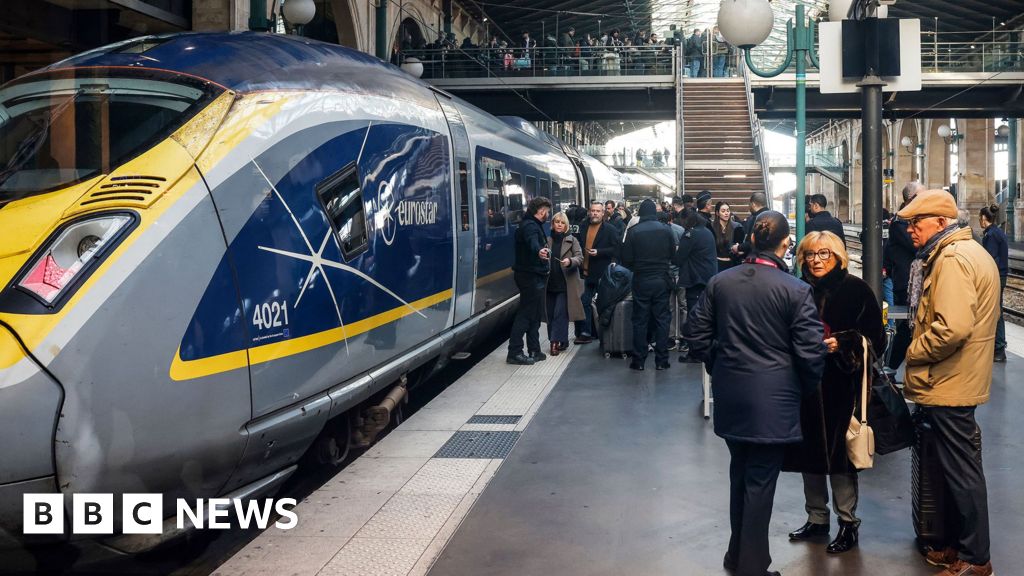
Eurostar and Le Shuttle services through the Channel Tunnel resumed after an overhead power supply fault and a broken-down Le Shuttle train blocked all routes, causing thousands of passengers major disruption and the cancellation of the majority of London services to Paris, Amsterdam and Brussels. Getlink said overnight repairs restored bi-directional services by Wednesday morning, although knock-on delays persist (Calais delays down to ~1 hour from six) and Eurostar has cancelled three morning departures while adding one extra London–Paris service; affected passengers are entitled to a 100% refund and a 150% e-voucher. The incident highlights operational and reputational risk for tunnel operator Getlink and Eurostar and could result in incremental compensation and short-term traffic impacts, but is unlikely to drive broader market moves.
Market structure: The immediate winners are ferry/freight operators and short-haul airlines that can pick up displaced passengers and vehicles; DFDS (DFDS.CO) and easyJet (EZJ.L) stand to see 1–5% incremental weekend volume if disruptions recur. Losers are the Channel Tunnel operator Getlink (GET.PA) via compensation payouts, PR damage and potential short-term revenue loss (single-digit % of weekly revenue), plus rail-ticket sellers who face churn and refunds. Pricing power shifts marginally toward alternative routes (ferries/air) during outages; sustained reliability issues would permanently erode rail modal share by several percentage points over 12–24 months.
Risk assessment: Tail risks include a prolonged multi-week tunnel closure (low probability, high-impact) forcing rerouting of freight, large insurance/regulatory claims, and accelerated capex for redundancy at Getlink, which could raise leverage by 2–4 pts. Immediate window (days): operational delays and elevated compensation; short-term (weeks/months): revenue repricing and consumer confidence hit; long-term (quarters/years): possible regulatory scrutiny and higher maintenance capex. Hidden dependency: single overhead power system and single-train blockages create outsized operational risk that is not priced into many transport equities.
Trade implications: Tactical: take a small, event-driven short on GET.PA (1–2% portfolio exposure or 1-month ATM PUTs) to capture an anticipated near-term 5–15% downside if markets mark down compensation/capex risk, while buying DFDS.CO (1–2%) as a relative beneficiary for 4–12 weeks. Pair trade: long DFDS.CO vs short GET.PA to neutralize macro FX/broad travel demand; hedge with 1-month options if implied vol < historical vol +20%. Rotate away from high‑exposure rail-ticket platforms into ferries/airlines for the next 2–8 weeks; reassess after 60 days.
Contrarian angle: Consensus treats this as a one-off holiday glitch; that underestimates systemic single-point-of-failure risk and regulatory reaction potential. If Getlink is punished sharply on the first headline move, a mean-reversion long at 20–30% drawdown makes sense given its monopoly asset — consider buying on a >20% pullback with a 12–36 month horizon. Unintended consequence: heavier short-term capex could justify higher tariffs or government support, creating a convex recovery scenario for Getlink equity over 1+ years.
AI-powered research, real-time alerts, and portfolio analytics for institutional investors.
Request DemoOverall Sentiment
mildly negative
Sentiment Score
-0.25
