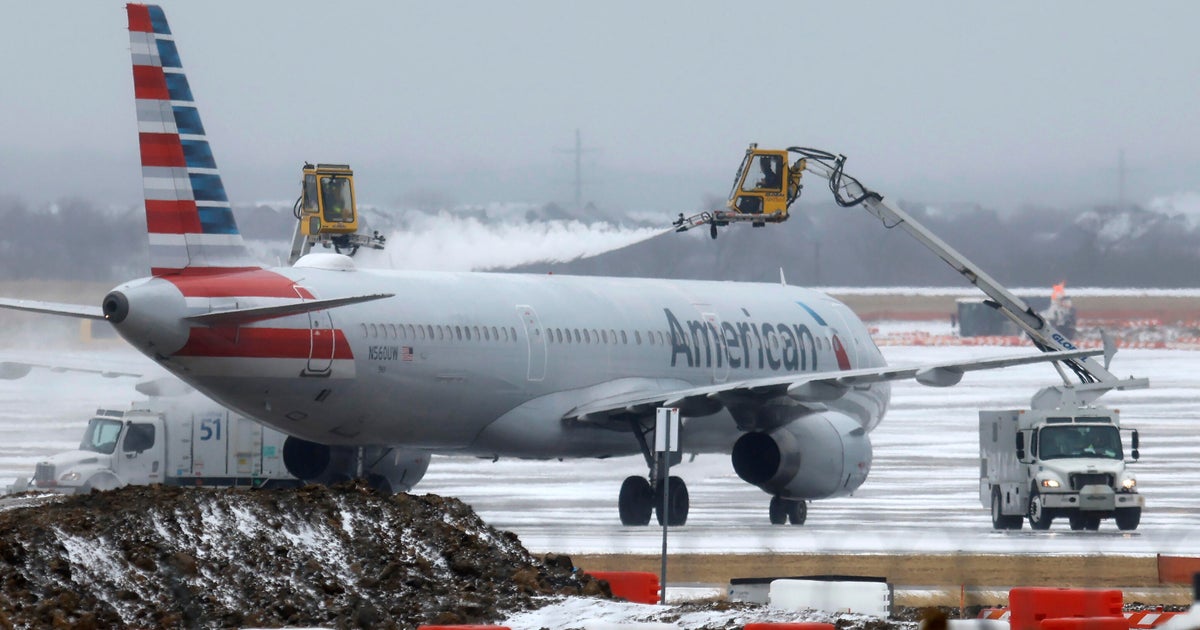
A major winter storm forced American Airlines to cancel more than 4,600 U.S. flights and delay over 2,300 flights across Saturday through Monday, with Dallas/Fort Worth (DFW) — the carrier's largest hub — particularly hard hit. Chief Customer Officer Heather Gordon issued an apology, described the operation as "all hands on deck," and urged customers to use the airline app and take advantage of travel flexibility; the disruption implies near-term operational costs, potential revenue loss from flight cancellations and customer-recovery expenses, and short-term reputational risk for the carrier.
Market structure: This event disproportionately hurts American Airlines (AAL) because DFW is a concentrated hub—4,600 cancellations and 2,300 delays over 3 days imply near-term incremental cash/recovery costs and revenue attrition likely in the range of $50–$200M this quarter, pressuring margins and liquidity. Competitors with more diversified hub footprints (UAL, DAL) or stronger operational recovery metrics will steal short-term share on key business/leisure routes; low-cost carriers with flexible crews (LUV) may recover faster regionally. Cross-asset: expect AAL single-name credit spreads to widen modestly and AAL equity IV to spike 20–40% intraday; jet fuel futures should see limited structural move but short-term demand dip can slightly lower crack spreads.
Risk assessment: Tail risks include DOT regulatory action or class-action suits that could add "tens to low hundreds of millions" in penalties, union/staffing constraints that prolong recovery, or cascading IT/crew-scheduling failures extending disruption beyond 2 weeks. Time horizons: operational hit = days; Q1 margin/headline risk = weeks–months; reputational/market-share effects = quarters. Hidden dependencies: hub concentration, crew domiciles, and IT resiliency; a subsequent weather wave within 7–21 days is a high-probability catalyst that would amplify losses.
Trade implications: Tactical short AAL exposure via near-term put spreads (3–6 week expiries) to capture IV and event-driven downside; pair long DAL/UAL vs short AAL for 1–3 months to express ops-relative strength. Reduce gross airline cyclicality for the next quarter and rotate 2–4% into airport operators or travel platforms with pricing power. Entry: act within 48–72 hours of continued cancellations; exit on 50% realized option P/L, normalization of cancellation rate to <1% over 72h, or within 6–8 weeks.
Contrarian angles: The market may overprice permanent damage—if AAL equity drops >12% intraday this could present a buy-on-mean-reversion for a 3–12 month horizon because historical weather-driven shocks typically mean-revert within 4–8 weeks. However, don’t underestimate follow-on regulatory/compensation headlines; if DOT opens a formal probe in 30 days, lock in profits or widen protection. Monitor specific KPIs: 72-hour cancellation rate, AAL on-time % (target recovery >85% within 2 weeks), and guidance changes for unit revenue >‑2% before reversing stance.
AI-powered research, real-time alerts, and portfolio analytics for institutional investors.
Request DemoOverall Sentiment
moderately negative
Sentiment Score
-0.45
Ticker Sentiment
