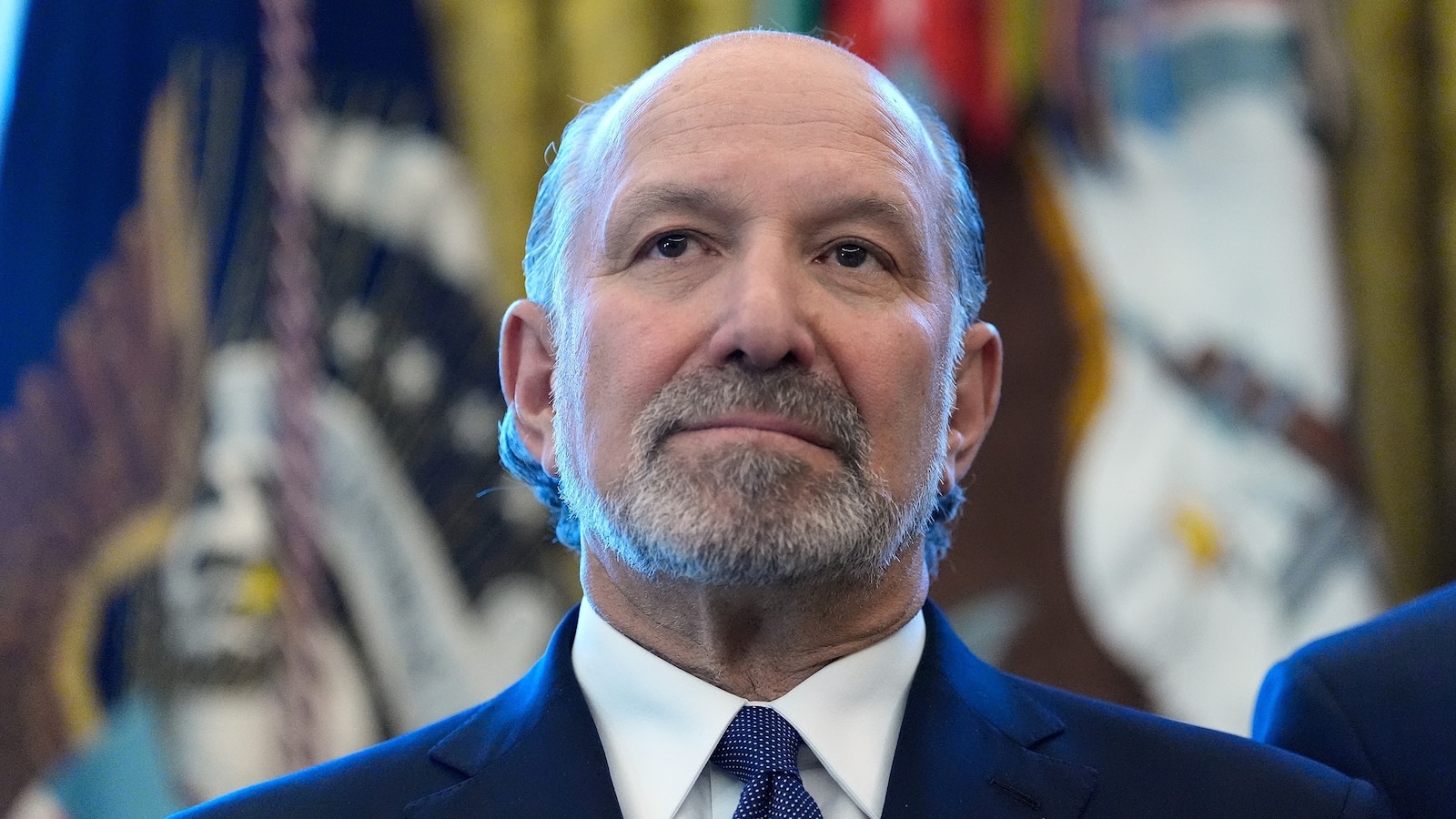
Commerce Secretary Howard Lutnick is facing bipartisan calls to resign after Justice Department documents indicate he remained in contact and conducted business with Jeffrey Epstein as late as 2011–2018, contradicting his prior claims of no post-2005 interactions. Lawmakers are seeking unredacted files, considering subpoenas and direct questioning, while the White House has defended Lutnick; the episode introduces reputational and governance risk for the Commerce Department and raises the prospect of disruptive oversight or personnel change.
Market structure: This is a political/governance shock with concentrated reputational risk around the Commerce Secretary rather than an economy-wide shock; expect transient risk-off in small caps and politically-exposed names for 1–4 trading days and modest safe-haven bid in Treasuries and USD. Direct winners: defensive sectors (Consumer Staples XLP, Utilities XLU) and long-duration Treasuries (TLT); losers: high-beta small caps (IWM) and event-sensitive equities that price political stability. Cross-asset: implied equity volatility (VIX) may tick +2–5 vol points intraday; 2s10s could flatten by 5–15 bps on safe-haven flows.
Risk assessment: Tail risks include resignation triggering a contested nomination or policy pause that could delay trade/tech export actions (low probability, high impact) and prolonged Congressional investigations that increase regulatory scrutiny on industries tied to Commerce policy. Immediate window: days for market reaction; short-term: 2–12 weeks while hearings/subpoenas develop; long-term: quarters if a replacement alters trade/export regimes. Hidden dependencies include executive branch continuity risk affecting trade deals and export licensing (semiconductor supply chain exposures). Key catalysts: unredacted document releases, any subpoena/resignation within 14–60 days, or bipartisan momentum to add him to hearings.
Trade implications: Tactical hedges favored — increase 1–2% duration exposure (TLT) for 30–90 days and buy 1–2% portfolio protection via SPY or IWM puts if VIX <18 (cost-efficient). Relative trades: pair long XLP (2%) / short IWM (2%) for 1–3 months to capture flight-to-quality; consider long USD via UUP if headlines intensify. Options: buy 3-month put spreads on IWM (e.g., 5–10% OTM) to limit premium outlay while capturing downside if hearings widen.
Contrarian angle: Markets likely overprice governance risk—if White House publicly sustains Lutnick and no resignation occurs within 7–14 days, mean reversion is probable and small caps could snap back 3–7%; that creates a tactical long-mean-reversion entry. Historical parallels (mid-level Cabinet scandals) show 1–4% S&P drawdowns at worst with full recovery in 2–8 weeks; avoid structural sector rotations unless policy changes are announced. Monitor thresholds: resignation/subpoena news or 10+ bps 10y move as triggers to increase or unwind hedges.
AI-powered research, real-time alerts, and portfolio analytics for institutional investors.
Request DemoOverall Sentiment
mildly negative
Sentiment Score
-0.30
