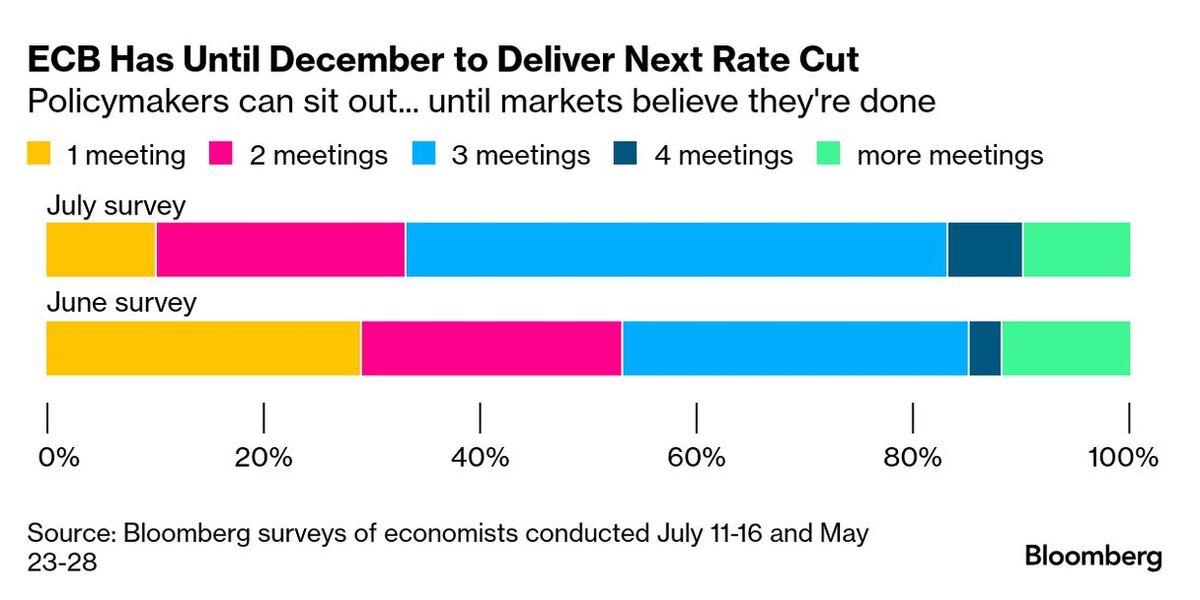
A Bloomberg survey of economists suggests the European Central Bank could delay its final interest rate cut until December without markets concluding that its easing cycle is over, a longer period of tolerance than previously anticipated due to trade uncertainty. While a majority still projects the final 25-basis-point reduction to 1.75% in September after an expected pause next week, half of respondents now believe the ECB can pause for three meetings before traders assume borrowing costs have reached their floor.
Market expectations for the European Central Bank's monetary easing trajectory are showing increased flexibility, primarily driven by trade-related uncertainty. A Bloomberg survey of economists indicates that while the consensus still points to a final 25-basis-point cut in the deposit rate to 1.75% in September, there is a growing belief the ECB could delay this move until December without signaling an end to its easing cycle. This represents a significant shift in perceived market tolerance, with half of the respondents now believing the ECB can pause for three consecutive meetings before investors assume borrowing costs have bottomed. The underlying driver for this extended patience is persistent uncertainty over trade, which affords the central bank more room to assess incoming data before committing to its final policy action.
AI-powered research, real-time alerts, and portfolio analytics for institutional investors.
Request DemoOverall Sentiment
mixed
Sentiment Score
-0.15
