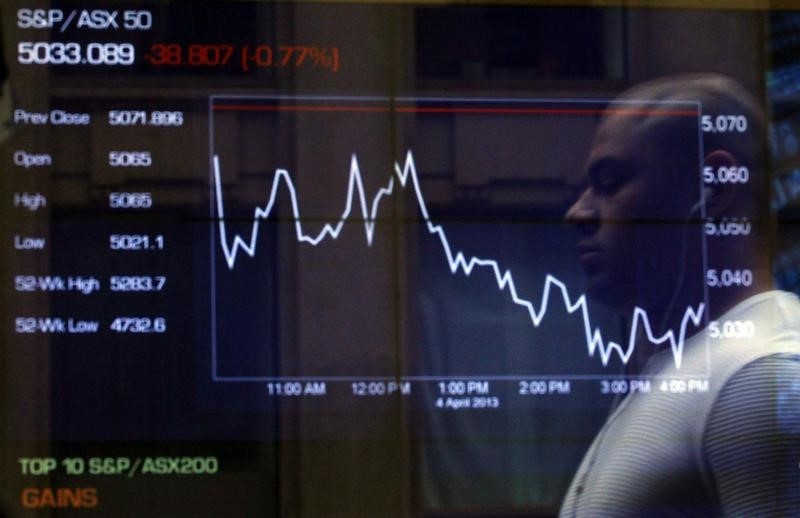
Headline notes oil surged after Yemen’s Houthi attack on Israel; in-session futures showed May WTI +1.64% to $101.27/bbl and June Brent +2.47% to $107.92/bbl. Australia’s S&P/ASX 200 fell 0.65% as IT, Financials and Consumer Discretionary led losses; top gainers included Greatland Resources (+10.14%) and South32 (+9.06%), while Zip Co (-6.01%), Judo Capital (-5.88%) and Block (-5.80%) were the largest decliners. S&P/ASX 200 VIX rose 5.44% to 17.07, gold futures were up 0.21%, and AUD/USD was essentially flat at ~0.69.
The immediate cross-asset effect is an orthodox risk-off rotation but with concentrated commodity-led mechanics: funding flows move away from rate-sensitive beta into hard-assets and headline-protected exposures, lifting commodity FX and gold while pushing equity vol higher. This re-prices cash-and-carry economics across the oil complex (upstream capture vs downstream squeeze) and re-allocates capital toward producers who can convert price moves into near-term free cash flow.
Second-order supply-chain impacts will show up unevenly over weeks: freight and marine insurance rate resets raise landed costs for just-in-time retailers and auto parts producers, compressing margins for names with thin pricing power; conversely, integrated miners and domestic metals producers with local energy contracts gain optionality as input-cost inflation is directly passed through to finished metals. Banks and FCM desks see elevated OTC energy options volumes and balance-sheet usage, widening trading lines and funding costs for marginal producers — a liquidity stratification that will determine which smaller E&Ps survive a prolonged shock.
The path for prices and risk premia is binary over 1–3 months: either conflict-related disruption becomes a chronic wedge in throughput and the market re-rates structurally higher risk premia, or rapid de-escalation + incremental spare capacity or releases from strategic reserves normalizes spreads. Tail-risks to monitor: a sustained spike that forces political releases (fast reversal) versus a liquidity-driven cascade in smaller E&P credit leading to physical shut-ins (prolonged tightness). Time horizons: trading opportunities within days-weeks; positionable alpha for equities and options over 1–6 months.
AI-powered research, real-time alerts, and portfolio analytics for institutional investors.
Request DemoOverall Sentiment
mildly negative
Sentiment Score
-0.25
