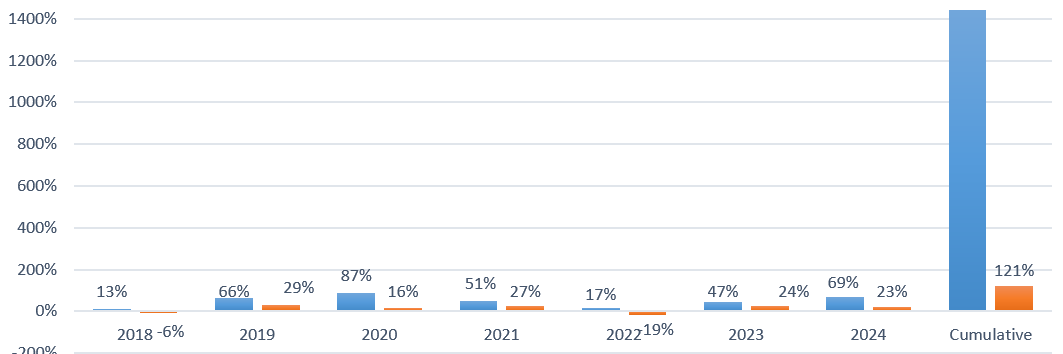
A recent pullback has reset valuations in AI and high-growth names, creating what the author describes as compelling buy opportunities in leaders such as Nvidia, AMD, Oracle and Micron, while fundamental drivers remain intact via robust earnings, strong guidance and ongoing infrastructure investment. The piece cites a dovish Fed outlook and potential rate cuts plus large government AI initiatives (e.g., the Genesis Mission) as catalysts to sustain AI momentum, and projects an S&P 500 target of 7,000–7,200 by year-end and 8,000 in 2026, supporting a bullish allocation stance toward AI-related equities.
Market structure: The near-term winners are GPU and accelerator suppliers (NVDA, AMD, MRVL) and software/infrastructure vendors that capture recurring cloud spend (ORCL, META indirectly). Pricing power will concentrate with NVIDIA in training accelerators and ORCL in data management — expect ASPs for high-end GPUs to rise 5–15% YoY if hyperscalers maintain current build plans, squeezing mid-tier OEM margins (DELL, legacy OEMs). Strong demand signals a multi-year capex cycle for datacenters; memory and specialized ASIC supply may be tight for 2–4 quarters, keeping semiconductor suppliers in pricing leverage and lifting relevant commodity demand (copper, specialty gases).
Risk assessment: Tail risks include export-control escalation to China, a Fed rate surprise (hawkish pivot) that re-prices growth, or a major AI safety/regulatory clampdown that curtails enterprise adoption — each could knock 20–40% off high-multiple names within weeks. Immediate (days) risk centers on earnings/guidance volatility; short-term (months) on hyperscaler capex cadence; long-term (years) on structural adoption and geopolitical fragmentation of supply chains. Hidden dependency: hyperscalers’ discretionary capex and NVIDIA’s single-vendor concentration; monitor hyperscaler capex guides and TSMC capacity utilization as leading indicators.
Trade implications: Tactical allocation — overweight NVDA (core accelerator exposure) and ORCL (sticky software margins) while underweight/shorting legacy hardware (DELL) and small-cap AI plays with negative free cash flow. Use 3–9 month option structures to express directional views: buy 3–6 month NVDA call spreads (10–25% OTM) and buy ORCL 6–12 month LEAPS for asymmetric upside. Rotate into semis and infra on any <10% pullback; de-risk if NVDA or AMD report guidance misses by >5% revenue or if 10-year yield rises >50bp in 30 days.
Contrarian angles: Consensus underestimates concentration and execution risk — NVDA dominance could invite regulation or customer diversification (increased custom ASIC builds by Google/AWS) that compresses multiples beyond fundamentals. Conversely, ORCL is underappreciated as a defensive play with recurring revenues and could outperform if macro weakens but AI spending continues. Historical parallels: 2016 cloud capex acceleration shows durable multi-year spend after initial hype; unlike 1999, this cycle has tangible revenue and margin expansion, but beware momentum overheating and mean reversion in small-caps.
AI-powered research, real-time alerts, and portfolio analytics for institutional investors.
Request DemoOverall Sentiment
strongly positive
Sentiment Score
0.65
Ticker Sentiment
