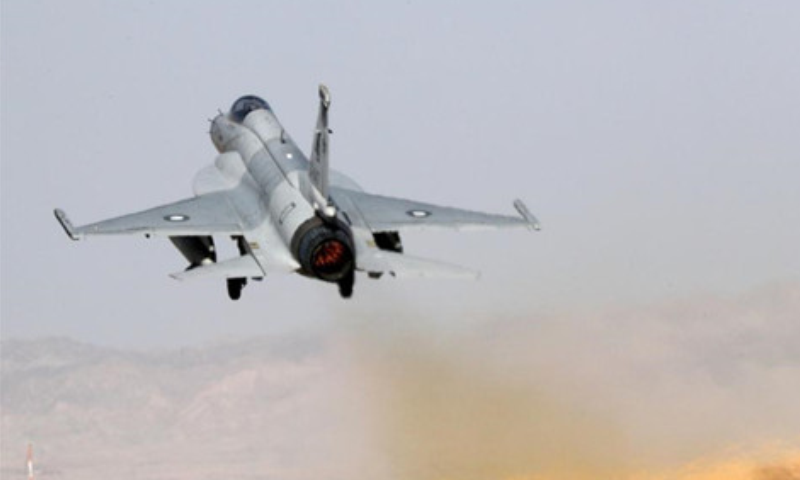
International interest in the China-Pakistan JF-17 fighter has surged — Iraq, Bangladesh, Indonesia and reportedly Saudi Arabia and Libya have expressed interest — after Pakistan highlighted the type's performance in May 2025. Pakistan currently builds fewer than 20 JF-17s per year, with 58% of production and final assembly in Pakistan and 42% of components (avionics) supplied by China; analysts say China could help scale production by adding lines or shifting component manufacture. For investors, the story signals a potential growth inflection for Pakistan's defense manufacturing and downstream suppliers, but near-term capacity constraints and the need for Chinese assistance temper immediate export-driven revenue visibility.
Market structure: The immediate winners are China-linked OEMs and Pakistan's nascent airframe suppliers (higher demand for low-cost fighters), while premium Western fighters (Lockheed F-16/F-35 sales pipeline) face margin pressure in price-sensitive markets. Current Pakistan output (<20 jets/year) implies supply inelasticity short-term; if China helps ramp to 40–60/yr within 12–24 months that shifts pricing power to the low-cost segment and compresses bid prices for single-engine light fighters by an estimated 10–25% in targeted emerging-market tenders.
Risk assessment: Tail risks include Western export controls or sanctions on avionics/component suppliers (6–18 month shock), or a regional military escalation after exports that triggers rapid sanctions and EM flight-to-safety (bond spreads +100–300bps for Pakistan/region). Near-term (days–weeks) market moves will be news-driven and small; medium-term (3–12 months) procurement decisions and factory-capacity announcements are critical; long-term (2–5 years) the main dependency is China’s willingness to transfer manufacturing and finance capacity expansion.
Trade implications: Tactical plays favor long exposure to global defense/aircraft supply-chain beneficiaries and select materials suppliers: A&D ETF (ITA) or large primes with export diversification (RTX, LMT) for 3–12 months, plus specialty metals (ATI) for 6–18 months. Consider pair: long ITA (1–2% portfolio) / short Saab (SAAB-B or SAABY OTC, 0.5–1%) to capture displacement in emerging-market fighter tenders. Use 3–9 month call spreads to limit premium outlay and set add-on triggers on confirmed export orders >20 units.
Contrarian angles: Consensus underweights the signaling effect: repeated export wins would accelerate Chinese-Pakistani supply-chain integration and push more component sourcing into China, disadvantaging non-Chinese suppliers over 2–4 years (possible structural market share shift of 5–15% in low-cost fighter market). The overdone reaction would be to assume large volume immediately; if confirmed orders remain <30 units total, impact on public suppliers and commodities will be minimal. Monitor order announcements, Pakistan production-rate confirmations, and any Western policy responses as binary catalysts.
AI-powered research, real-time alerts, and portfolio analytics for institutional investors.
Request DemoOverall Sentiment
mildly positive
Sentiment Score
0.28
