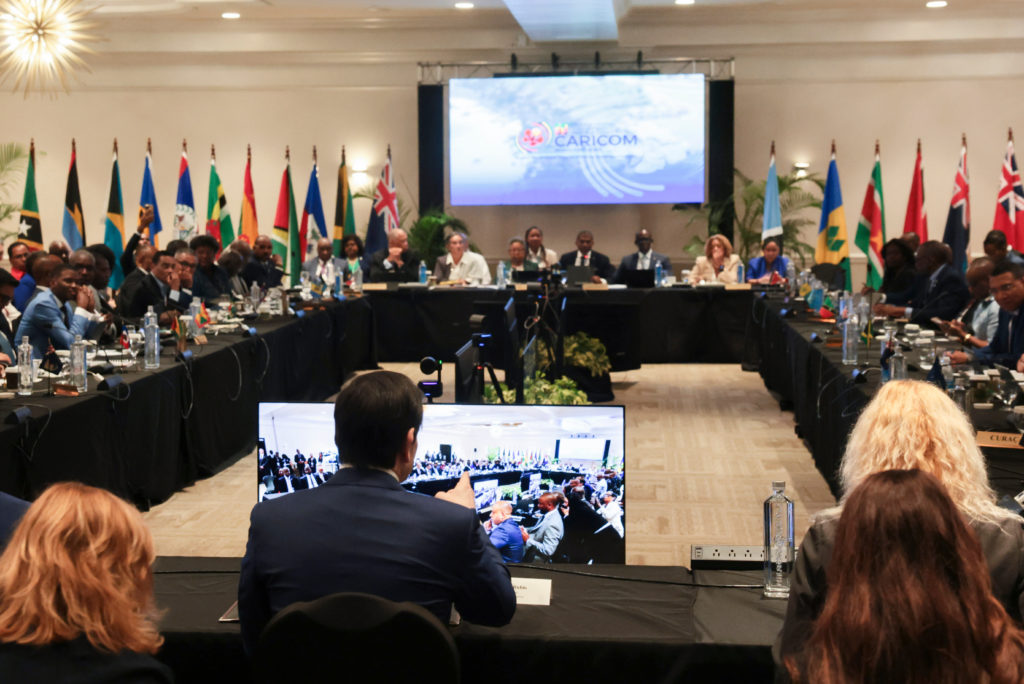
U.S. Secretary of State Marco Rubio defended the Trump administration's recent military operation that captured Venezuelan President Nicolás Maduro and the subsequent effective U.S. takeover of Venezuela's oil sector, telling Caribbean leaders the country and region are better off eight weeks after the raid. The administration signaled closer hemispheric security cooperation while the U.S. Treasury slightly eased restrictions on Venezuelan oil sales to Cuba; regional leaders raised legal and humanitarian concerns and warned of wider migration and stability risks. The developments increase geopolitical risk in the Caribbean and create upside potential for short-term shifts in regional energy flows, but also heighten political and security uncertainty that investors should monitor for contagion into emerging-market and energy exposures.
Market structure: The U.S. “takeover” of Venezuelan oil and heightened Caribbean military posture shifts near-term winners to integrated energy majors (XOM, CVX, COP) and refiners able to process heavy sour crude (VLO, MPC), plus defense contractors (LMT, NOC) that benefit from sustained naval deployments. Losers include Venezuelan creditors/PDVSA bondholders, Cuban fuel-dependent sectors, and regional EM borrowers; expect 1–3% widening in Caribbean/LatAm sovereign spreads if instability persists. Commodity-wise, a 100–300 kb/d disruption in Venezuelan heavy crude would likely lift Brent/WTI spreads by $3–8/bbl and raise heavy-sour crack spreads.
Risk assessment: Tail risks include sabotage of Venezuelan fields, legal/third-party sanctions on U.S. companies, or escalation with Cuba/China that triggers broader trade frictions — each could spike oil vol +40–60% and EM CDS. Immediate (days): elevated volatility and naval movements; short-term (weeks–months): oil price re-pricing and widening EM spreads; long-term (quarters–years): capital investment cycles to rebuild Venezuelan output will determine sustained supply. Hidden dependency: physical capacity (skilled crews, diluent, export logistics) likely limits quick production ramps despite political control.
Trade implications: Favor 3–6 month tactical longs in large-cap integrated energy (XOM, CVX) and selective defensives (LMT) while hedging EM exposure via sovereign CDS or short LATAM sovereign ETFs. Options: implement buy-call spread on Brent (3-month) to capture $3–8/bbl upside with capped premium; buy 3–6 month call spreads on XOM/CVX (10–20% OTM). Pair trade: long CVX (2–3% portfolio) vs short U.S. pure-play shale (EOG) to exploit heavy-crude vs light-sweet dynamics.
Contrarian angle: Markets may assume U.S. control equals immediate barrel influx — history (Iraq 2003) shows production recovery can take years; near-term constraint in technicians/logistics is underpriced. Conversely, defense exposure appears underbought relative to increased sustained deployments; expect outperformance if tensions persist beyond 90 days. Watch for higher shipping insurance rates and rerouted trade lanes as an under-appreciated inflationary channel impacting global logistics-sensitive names.
AI-powered research, real-time alerts, and portfolio analytics for institutional investors.
Request DemoOverall Sentiment
moderately negative
Sentiment Score
-0.25
