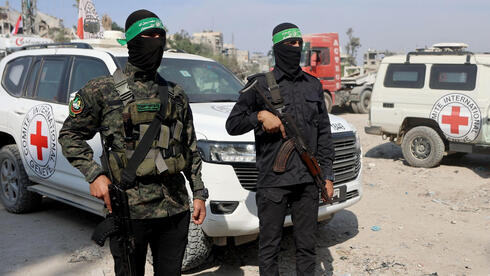
A fragile six-week ceasefire in Gaza has allowed Hamas to work on reestablishing governance while it has delayed returning the bodies of three remaining hostages, a move Israeli officials say stalls triggering next-stage negotiations including disarmament. A senior Hamas delegation is in Cairo meeting Egyptian intelligence on ceasefire progress, captives and fighters held in tunnels, and a proposed technocratic international committee that would oversee a gradual process to “preserve” weapons—initially monitored by international forces and eventually transferred to the Palestinian Authority under UN or Arab-state oversight—while local police operate under the committee’s authority. Despite the truce, recent crossings of the demarcation line, ensuing shootouts and IDF strikes underscore the deal’s fragility, and Hamas is reported to be seeking arrangements to avoid handing over or destroying its arsenal.
A fragile ceasefire that has held for about six weeks is providing Hamas space to reestablish governance in Gaza while the group delays returning the bodies of the last three hostages—Sgt. First Class Ran Gvili, Dror Or and Thai national Sudthisak Rinthalak—which Israeli officials say is stalling the trigger for next-stage negotiations including disarmament. A senior Hamas delegation led by Khalil al-Hayya arrived in Cairo to meet Egyptian intelligence, with discussions reportedly focusing on ceasefire progress, “captives and fighters” in tunnels and preparations for the second phase of the agreement.
Proposals under consideration would create a technocratic international committee to oversee a gradual process in which international forces monitor and separate factions, train local personnel, and eventually transfer weapons to the Palestinian Authority under UN or Arab-state oversight; Hamas has signaled it seeks to “preserve” weapons and has reportedly approached the PA to store existing arms rather than destroy or surrender them. The current deal prohibits storing, importing or manufacturing weapons, so any deviation or storage arrangement would materially affect the disarmament timeline and enforcement mechanisms.
The truce remains brittle: recent breaches of the demarcation (“yellow line”), shootouts and Israeli strikes underscore immediate escalation risk, while Hamas’ public denial of organizational responsibility for at least one incident adds ambiguity. Sentiment metrics show a moderately negative, volatile tone with a modest market-impact score (0.35), implying regional-news-driven short-term volatility without a clear signal for broad market disruption; key near-term catalysts are hostage returns and outcomes from the Cairo negotiations.
AI-powered research, real-time alerts, and portfolio analytics for institutional investors.
Request DemoOverall Sentiment
moderately negative
Sentiment Score
-0.45
