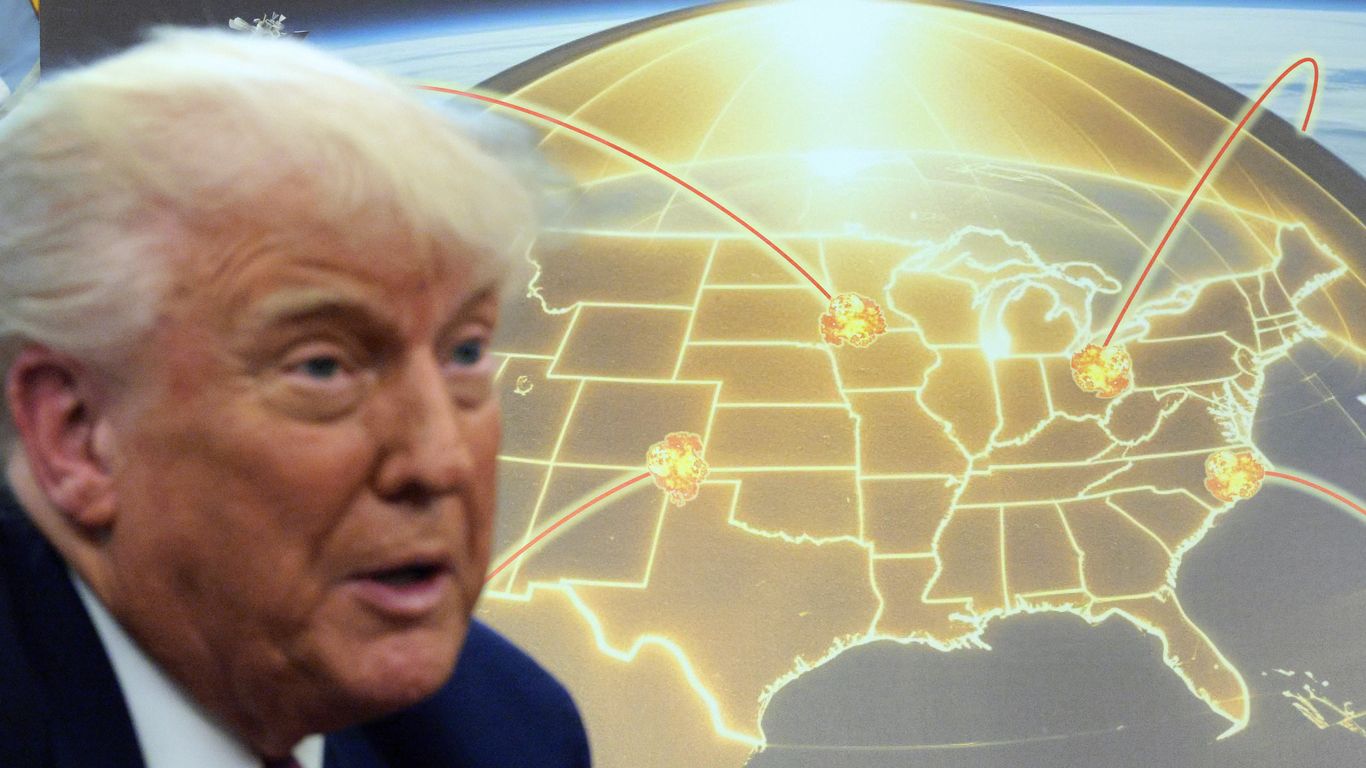
President Trump's proposed 'Golden Dome' missile defense system, envisioned as a 24/7 overhead defense system, faces significant hurdles despite industry enthusiasm, including bureaucratic challenges and technological readiness; experts cite concerns about the organizational structure and authorities needed for effective implementation, while the ambitious $175 billion price tag may be insufficient given the scope of the project and potential adversary countermeasures. The project aims to integrate various technologies to counter a range of missile threats, requiring seamless communication and coordination across different systems, raising questions about the feasibility of meeting political deadlines with current technical capabilities.
President Trump's "Golden Dome" initiative, a proposed continental 24/7 missile defense system, presents a complex outlook characterized by ambitious goals, significant skepticism, and substantial execution risks. While envisioned with a three-year initial deployment timeline and a $175 billion preliminary price tag, analysts suggest this cost is likely underestimated, particularly considering the central role of expensive space-based interceptors. Bureaucratic hurdles are a primary concern, with experts like Tom Karako of CSIS emphasizing the need for streamlined organization and authorities rather than new administrative layers. The project, to be led by Gen. Michael Guetlein, has polarized observers; Laura Grego from the Union of Concerned Scientists highlighted the lack of detailed public information and the potential for adversaries to develop countermeasures against such a comprehensive system. Conversely, the defense industry, including satellite bus maker Apex which recently secured a $200 million Series C and is actively investing in R&D, expresses strong enthusiasm, believing breakthrough technologies now make such a system feasible, echoing Reagan's Strategic Defense Initiative. A Boeing-led team recently completed 20 new missile silos in Alaska, a tangible step, but the critical challenge remains aligning political deadlines with technical readiness, with uncertainty over how much of the system projected for 2028 relies on existing versus unproven technologies. The project aims to counter a wide array of threats, from ICBMs to hypersonic vehicles, necessitating intricate, millisecond-level coordination between diverse systems.
AI-powered research, real-time alerts, and portfolio analytics for institutional investors.
Request DemoOverall Sentiment
mixed
Sentiment Score
0.10
Ticker Sentiment
