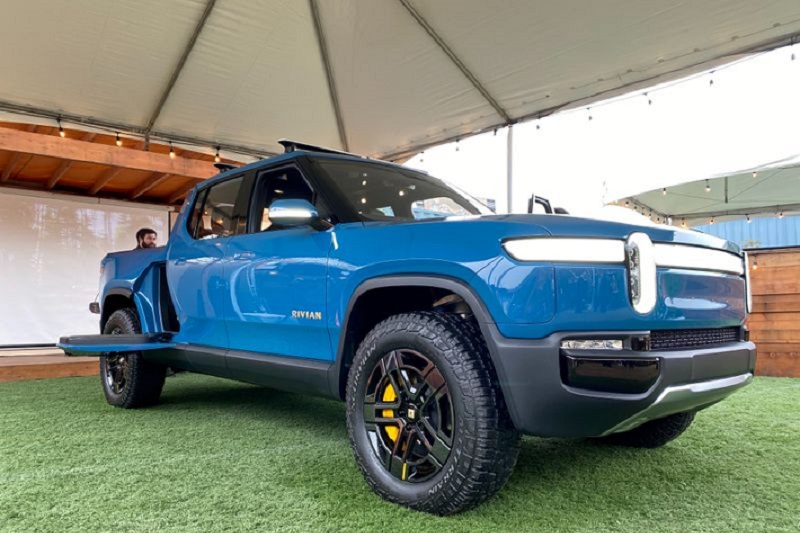
Rivian guided 2026 vehicle deliveries to 62,000-67,000 units and adjusted EBITDA to a loss of $2.10 billion to $1.80 billion, while capex is expected at $1.95 billion-$2.05 billion. Gross profit declined on a $100 million drop in automotive regulatory credit sales and a weaker product mix, but software and services revenue rose 49% year over year. The company also started R2 production and secured a $1 billion investment from Volkswagen Group.
Rivian’s update is less about near-term unit growth and more about the company proving it can turn a capital-intensive EV story into a platform business. The mix shift toward commercial vans is strategically important: it lowers headline ASPs, but it also creates a more annuity-like software/maintenance attach rate and a better path to gross margin durability than pure consumer demand exposure. The Volkswagen investment is the real signal here — it de-risks the balance sheet and suggests a potential OEM-scale validation path that could compress the company’s cost of capital if execution holds. The second-order winner is likely the supplier ecosystem tied to the new platform ramp: batteries, thermal systems, electronics, and manufacturing automation should see better visibility as R2 tooling scales. The loser set is the legacy EV cohort that still needs to finance growth through repeated capital raises; Rivian’s funding and product-cycle credibility makes the market more selective about which unprofitable OEMs deserve multiple support. A more subtle effect is on commercial fleet competitors: if Rivian can use software + service revenue to stabilize lifetime economics, it raises the bar for van programs that are still judged on upfront vehicle margin alone. Risk is execution timing, not demand. R2 production is where a 6-12 month hiccup would matter most, because the market will reward the stock for de-risking only if initial ramp data shows manufacturing learning curve improvements rather than just a fresh round of promises. The other near-term risk is margin dilution from mix and incentives: if regulatory credit income keeps normalizing, consensus may be too optimistic on the speed of EBITDA improvement even as deliveries rise. In that setup, the stock can still work, but only if investors are willing to underwrite a 2-year path rather than a quarterly beat story. Consensus may be underestimating the option value embedded in software/services. If Rivian can convert fleet relationships into recurring content and post-sale revenue, the valuation framework should move from auto cyclicality toward a blended OEM/platform multiple; that is the bull case the market often misses because it is not visible in unit guidance alone.
AI-powered research, real-time alerts, and portfolio analytics for institutional investors.
Request DemoOverall Sentiment
mildly positive
Sentiment Score
0.25
