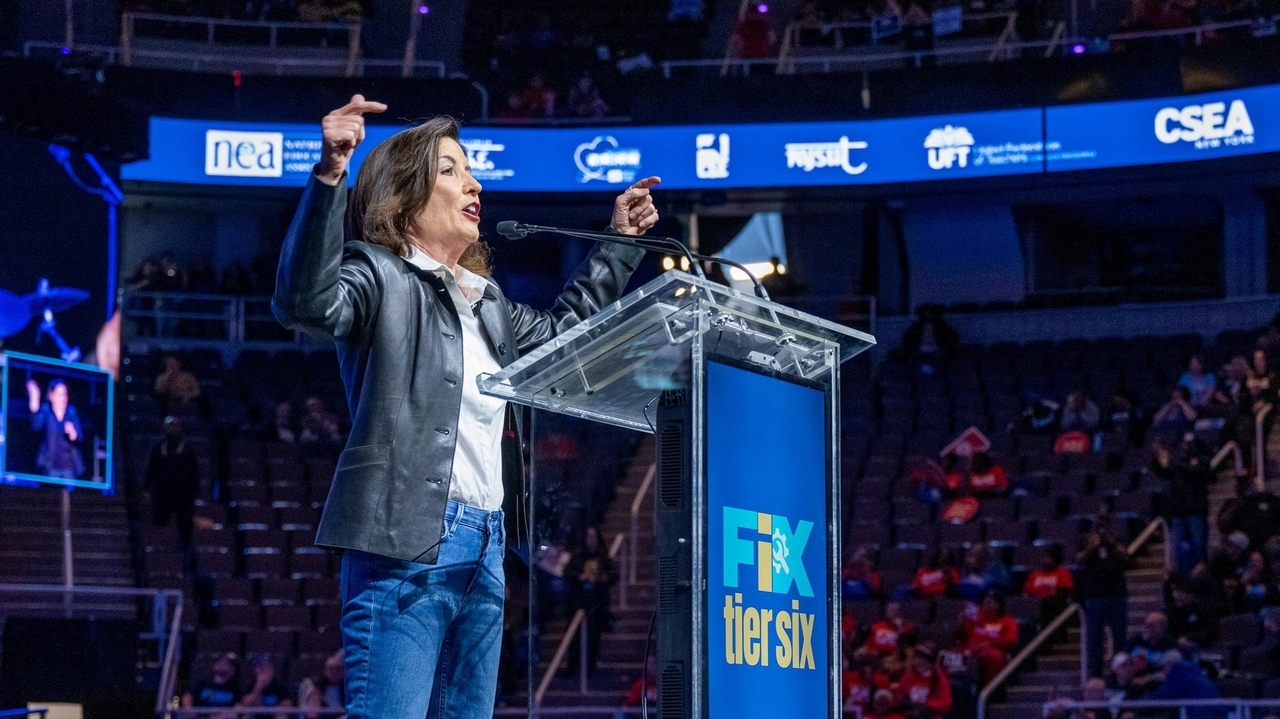
Lawmakers are negotiating a roughly $260 billion 2026-27 New York state budget and appear unlikely to meet the April 1 deadline, with policy disputes — not total spending — stalling a deal. Major contentions: Gov. Hochul wants to slow the 70% emissions-by-2030 target and tie new regs to a 2040 goal while keeping an 85% reduction by 2050; the Legislature proposes higher tax rates on annual incomes above $5 million and higher corporate taxes for companies with revenues ≥$5 million, which Hochul opposes. Hochul also seeks to ease SEQRA environmental reviews for housing/child-care/clean-energy projects and limit certain car-insurance payouts, measures that face pushback from environmentalists, progressive Democrats and consumer groups, creating near-term uncertainty for renewables, construction and insurers.
The budget theater in Albany is acting as a policy volatility amplifier: stakeholders pause spend and permitting decisions until clarity arrives, creating a 12–24 month pipeline risk for project developers and materially raising the option value of shovel-ready assets. For developers this raises financing costs — every 100 bps of spread adds ~3–5% to a typical housing project’s IRR hurdle, which will push marginal projects back or shift economics toward faster-payback infill plays.
The law-and-order tilt of potential liability reforms (civil payout limits, expanded prosecutorial tools) is a binary catalyst for P&C insurers and defense-side litigation boutiques; a plausible passage could improve insurers’ combined ratios by 100–300 bps and translate into a 5–15% EPS uplift over the next 12 months, while litigation/ballot-backlash could unwind those gains inside quarters. Concurrently, any multi-year ambiguity around climate and permitting will create a regime of stop-start capital allocation for renewables — sponsors will demand higher returns or pull projects, pressuring near-term M&A and project financings.
Tax-policy noise focused on the ultra-wealthy will reverberate through NYC transaction markets and high-margin service sectors: deferred gains, relocations or timing shifts can depress luxury real-estate trade volumes and discretionary spending by an estimated 5–15% in a stressed scenario, with the largest impact concentrated in the next 3–9 months around budget votes and municipal fiscal adjustments. The key watching windows are the final budget vote (days–weeks) for immediate market moves and a 6–36 month horizon for durable regulatory or statutory changes that reprice project pipelines, insurer fundamentals and real-estate cashflows.
AI-powered research, real-time alerts, and portfolio analytics for institutional investors.
Request DemoOverall Sentiment
mixed
Sentiment Score
-0.05
