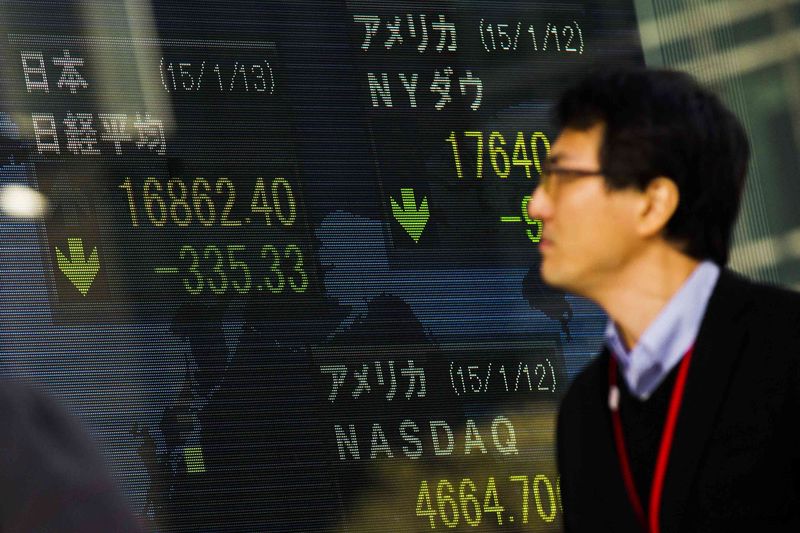
A tentative two-week ceasefire between the U.S. and Iran sparked broad risk-on moves: Brent crude plunged over 13% to $94.97/bbl and S&P 500 futures jumped more than 2%. Asian equities rallied sharply—South Korea’s KOSPI and Japan’s Nikkei 225 rose over 5% each, CSI 300 +2.3%, Hang Seng ~+3%, ASX 200 +2.5%, and Nifty futures +3%—while Samsung forecasted an eightfold Q1 profit, sending Samsung +6% and SK Hynix nearly +11%. This is a market-wide de-risking event that should lower energy risk premia and support regional equity exposures; monitor ceasefire durability and oil for potential volatility swings.
The market move reflects removal of a short-term geopolitical risk premium and a rapid re-allocation of cross-border flows into under-owned Asian cyclicals and tech. Expect 1–4 week flow dynamics to dominate: FX and equity futures buying into Korea and Japan, unwind of commodity longs, and compression of equity and oil vol, which can amplify rallies but leave positioning fragile.
Within technology, the AI-led demand impulse is real but will interact with classic semiconductor cyclicality: near-term revenue leverage is high, but lead-time expansion and incremental capex decisions by memory and waferfab owners create a material risk of inventory-driven oversupply 9–18 months out. That implies a two-phase trade — momentum capture now, defensive or hedged exposure into late-year capacity signals.
Energy second-order effects favor margin re-expansion in oil-consuming sectors (airlines, container shipping, refiners’ crack spreads) and temporarily reduces incentives for spot-market supply responses; conversely, OPEC+ policy or shipping-lane frictions can reintroduce a >20% oil spike within days. Volatility is likely to remain skewed: short-dated equity calls are expensive in favorites (semis), while tail-protection in oil and EM FX retains asymmetric value.
Key risk paths: (1) diplomatic talks collapse or proxy escalations — rapid risk-off within 24–72 hours; (2) OPEC+ signaling or production cuts that offset demand losses — oil rebounds over weeks; (3) inventory and capex disclosures causing tech revenue disappointment over 3–12 months. Manage sizing and time horizons accordingly; prefer defined-risk option structures around these catalyst windows.
AI-powered research, real-time alerts, and portfolio analytics for institutional investors.
Request DemoOverall Sentiment
strongly positive
Sentiment Score
0.75
