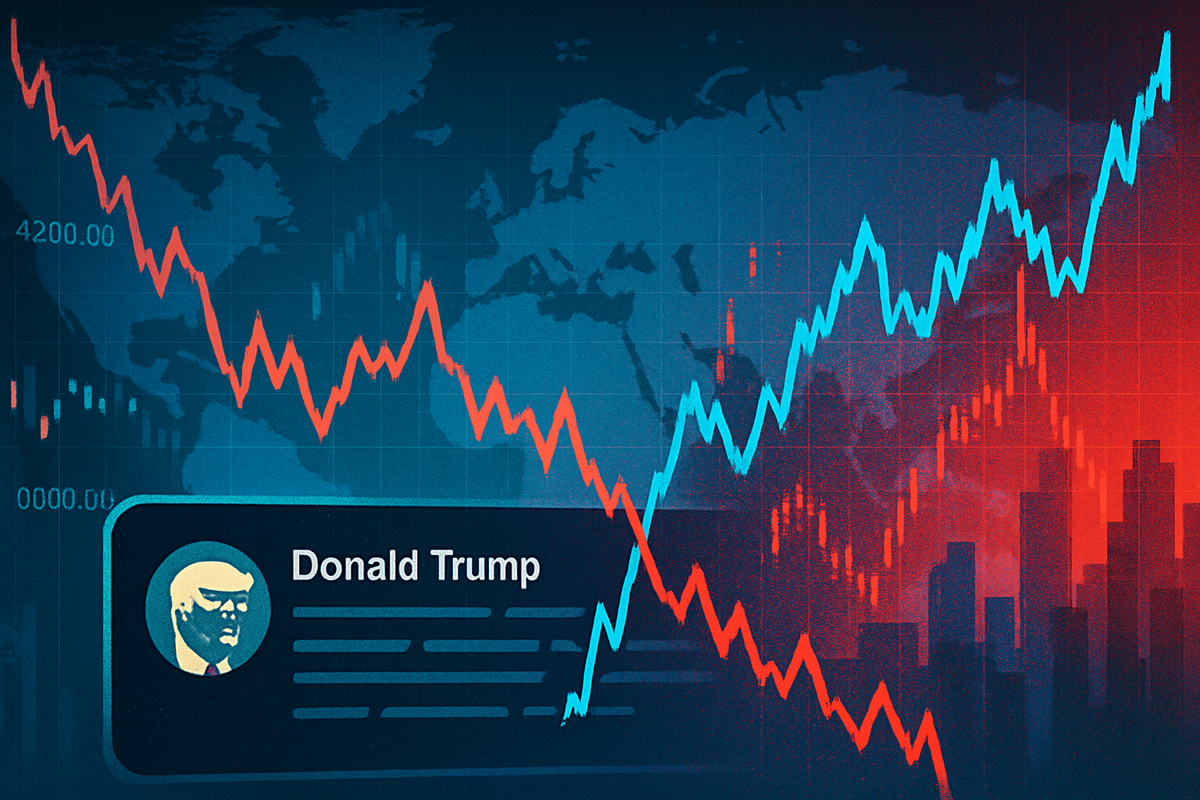
President Trump's social media pronouncements in 2025 have profoundly impacted financial markets, generating extreme volatility with tariff threats causing sharp declines (e.g., S&P 500 -2.7% on Oct 10) and subsequent conciliatory remarks triggering swift rebounds. This 'America First' agenda, marked by protectionist trade policies and deregulation, has accelerated global supply chain fragmentation, leading to increased costs and persistent inflationary pressures. While sectors like technology and automotive faced significant headwinds from tariffs, domestic manufacturing, energy, financials, and U.S. rare earth suppliers have benefited. Institutional investors must navigate continued market volatility, structural inflationary trends, and a strategic pivot towards domestic industries, necessitating agile portfolio management amidst evolving trade, fiscal, and regulatory landscapes.
President Trump's social media pronouncements in 2025 have demonstrably driven significant, immediate market volatility. On October 10, a tariff threat on Chinese imports led to the S&P 500 plummeting 2.7% and Nasdaq 100 losing 3.5%, while copper dropped 4.9%. Conversely, conciliatory remarks on October 12 triggered a swift rebound, with S&P 500 futures climbing 0.9%-1.1%, underscoring the direct impact of his digital footprint on investor sentiment and market direction.
This 'America First' agenda has created clear winners and losers across sectors. Technology giants like Apple and Nvidia saw billions in market value erased due to supply chain concerns and tariff threats, while General Motors reported a 32% Q2 2025 operating profit tumble, attributing $1.1 billion to tariff costs. In contrast, domestic rare earth suppliers like MP Materials and USA Rare Earth saw shares jump 11.07% and 15% respectively, benefiting from the focus on domestic production.
The broader implications include accelerated fragmentation of global supply chains, pushing companies towards 'just-in-case' logistics and increasing costs. This, coupled with universal tariffs, is projected to add a "substantial inflationary impulse," potentially increasing core Personal Consumption Expenditures (PCE) inflation. Deregulation is expected to benefit financials and energy, but also raises long-term environmental concerns.
Looking ahead, markets face sustained volatility and persistent inflationary pressures, challenging the Federal Reserve's ability to cut rates. The economic landscape will be reshaped by a redesign of global supply chains, incentivizing domestic manufacturing, and potential extensions of corporate tax cuts, which could increase national debt.
AI-powered research, real-time alerts, and portfolio analytics for institutional investors.
Request DemoOverall Sentiment
moderately negative
Sentiment Score
-0.50
Ticker Sentiment
