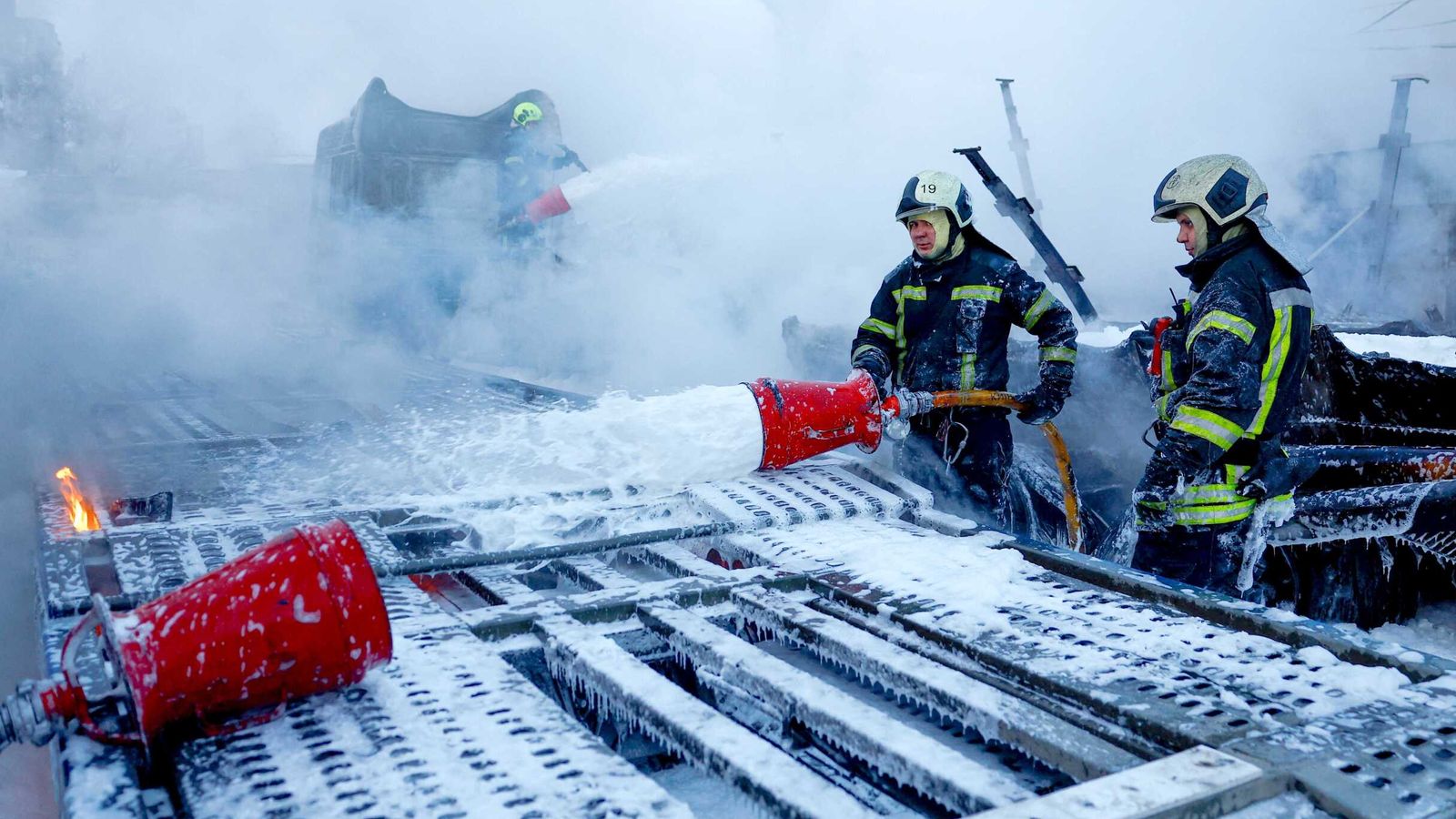
During trilateral talks in Abu Dhabi, Russia launched large missile and drone strikes on Kyiv and Kharkiv that cut power to roughly 1.2 million buildings amid -13C temperatures, killed one person and injured 31, while Ukraine and the US described talks as productive but without breakthrough. Kyiv says the strikes were timed to influence negotiations; the Kremlin reiterated demands for Ukraine to cede occupied territory and floated using nearly $5bn in US-frozen Russian assets to fund reconstruction. The attacks raise near-term geopolitical and utility/energy disruption risks and underpin upside pressure on defense and risk-premia-sensitive assets in the region while keeping prospects for a negotiated settlement uncertain.
Market structure: The strikes raise near-term winners (defense contractors, grid-hardening and heavy construction/materials) and losers (Ukrainian operators, regional travel, EM risk assets). Expect higher near-term pricing power for aerospace & defense suppliers (ITA, LMT, RTX) and selective commodity suppliers (steel, copper) as reconstruction and military demand lift orderbooks by mid-2026; energy security concerns tighten gas/oil risk premia, pushing European gas spreads wider than US equivalents.
Risk assessment: Tail risks include escalation to wider NATO involvement or energy-channel closures that would shock oil/gas (>$10–$20/bbl realized shock) and trigger sanctions-countermeasures that freeze trading counterparties. Immediate (days) sees risk-off equity flows and higher VIX; short-term (weeks/months) sees commodity repricing and defense capex re‑allocation; long-term (quarters/years) sees structural re‑regionalization of supply chains and elevated defense budgets.
Trade implications: Tactical buys should favor defense ETFs/large primes, precious metals as a flight-to-safety, and short-dated gas exposure for winter/flow disruption. Use options to hedge geopolitical gamma (VIX call spreads, puts on Europe VGK) and favor relative-value pair trades (A&D long vs European cyclicals short) with 1–6 month horizons and explicit stop-loss thresholds.
Contrarian angles: Consensus bids defense and energy; what’s missed is repricing risk in cyber/communications and niche suppliers (precision components, electronic warfare) that are less crowded and can outperform. Also reconstruction financing via frozen Russian assets is politically fraught—do not assume rapid capital inflows; market may overpay for visible defense names while overlooking smaller-cap suppliers and insurers bearing casualty/reinsurance risk.
AI-powered research, real-time alerts, and portfolio analytics for institutional investors.
Request DemoOverall Sentiment
strongly negative
Sentiment Score
-0.65
