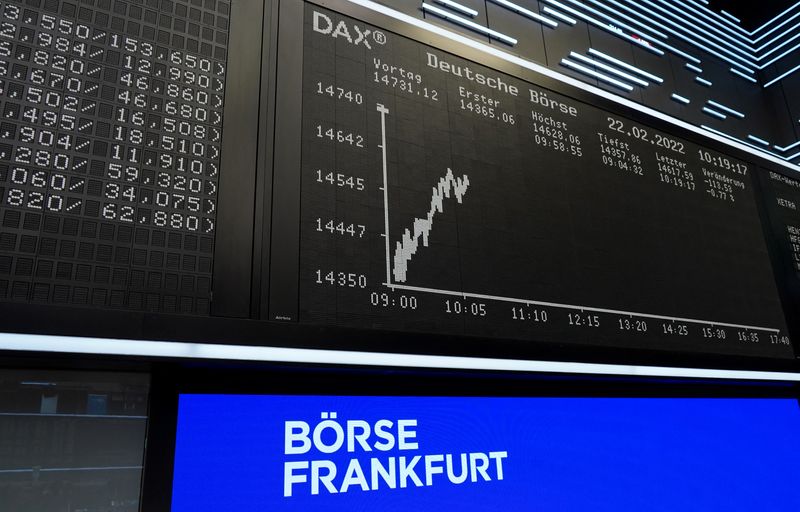
A conditional U.S.–Iran ceasefire agreement sparked a market-wide risk-on move: Brent futures plunged ~14% to $94.30 and WTI fell >15% to $95.77. European equities rallied broadly—German automakers +4–7%, luxury names +6–7%, banks across Europe jumped (Commerzbank ~+10%, Deutsche Bank +7.3%, Spanish banks +3.5–8%, French banks +5–10%, Italy banks index +6.5%)—and chipmakers gained 5–11%. The ceasefire materially re-priced geopolitical risk, benefiting cyclicals and banks while sharply weighing on energy names and commodity futures.
The market move is best read as a sudden collapse in the region-specific geopolitical risk premium, which favors balance-sheet-heavy cyclicals (European banks, luxury autos) and re-prices long-dated capex optionality in semiconductor equipment. A key second-order beneficiary is the entire maritime/shipping cost curve: lower perceived risk in the Strait reduces war-risk insurance and spot tanker charter rates, which in turn lowers working capital and timing friction for refiners, exporters and commodity traders — an under-appreciated boost to European trade-exposed industrial margins over the next 1–3 quarters.
For semiconductors, the reaction is timing-sensitive: ASML captures most of the durable capex optionality because its backlog conversion has very long lead times (6–18 months) — today’s risk-on lifts sentiment but won’t materially change revenue until later cycles. Mid-tier and momentum hardware names (SMCI, APP) are more exposed to near-term positioning flows than to actual order re-acceleration, making them susceptible to sharp mean reversion if macro momentum stutters.
Primary reversal catalysts are binary and fast: renewed hostilities, a high-profile shipping incident, or a sudden jump in crude can re-inflate the commodity risk premium within days and flip the trade. Conversely, a confirmed multi-month decline in shipping and insurance costs combined with visible ASML order activity would sustain the rally for 3–12 months. Central bank rate expectations are the wildcard — if risk-on pushes real yields down, the rally can extend; if it re-prices tighter rates, cyclicals will suffer.
Consensus is underweight the timing dimension: investors are treating sentiment moves as permanent demand recovery. That overstates the case for momentum names while understating the duration advantage of structural suppliers like ASML and the liquidity/leverage sensitivity of regional banks. A calibrated book that captures structural exposure while hedging crude/shipping tail risk is preferable to a full-blown chase of short-duration winners.
AI-powered research, real-time alerts, and portfolio analytics for institutional investors.
Request DemoOverall Sentiment
moderately positive
Sentiment Score
0.60
Ticker Sentiment
