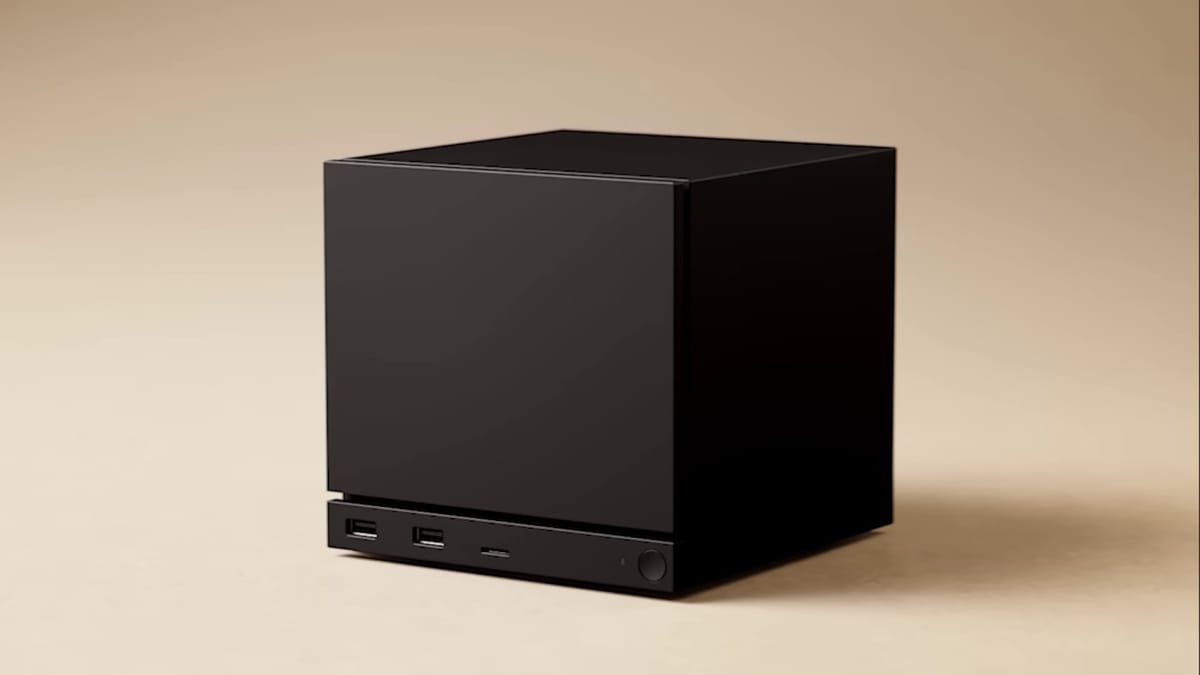
Valve announced three new hardware products — the Steam Machine (a consolized PC), the Steam Frame (a streaming-focused VR headset with foveated streaming and eye tracking), and a new Steam Controller — claiming the Steam Machine can deliver up to 4K at 240Hz or 8K at 60Hz with pricing comparable to modern pre-built PCs (broadly $500 to >$1,000; a $500 512GB model was floated as plausible). The piece notes install-base context: Steam Deck shipments ~3.7 million (Feb 2025), handheld PC market ~6 million vs. PS Vita 10–15 million, Switch 2 >10 million since its June launch, and PS5 >56 million as of April 30, 2024, underscoring the niche status of PC hardware but potential to expand market share. For investors, the announcement is strategically important for competitive dynamics with Nintendo/Sony and for retail/distribution and bundling choices, but it is unlikely to be an immediate market mover given Valve’s private status and uncertain execution and pricing.
Market structure: Valve’s Steam Machine primarily pressures mid/high-end console margin more than outright volume leaders — Sony (SONY) is the most exposed in incremental share/price compression if Valve prices <=$500 and gains >1M buyers in year-1. Winners are PC-component suppliers and retailers (potentially AMZN if Valve expands channels); Nintendo remains insulated due to first-party exclusives. Expect modest semiconductor demand uptick (GPUs) and only low-single-digit impact on aggregate console volumes in 12–24 months.
Risk assessment: Tail risks include major anti-cheat incompatibilities or a GPU supply shock pushing unit cost >$1,000 causing market failure, and regulatory scrutiny if Valve leverages Steam distribution to foreclose rivals — low probability but high impact. Immediate risks (days–weeks) are review sentiment and launch pricing; short-term (3–6 months) is retail distribution decision; long-term (12–36 months) is developer support and ecosystem lock-in. Hidden dependency: SteamOS/linux anti-cheat adoption is the gating factor for casual consumer retention.
Trade implications: Tactical trades should be sized small (1–2% book weight) and contingent on concrete signals: official MSRP, retail partners, and early reviews. If price <=$600 and Valve commits to big-box distribution, overweight AMZN (retail flow) and semiconductor suppliers; if Valve limits retail channels, favor long Alphabet (GOOG) exposure to cloud/streaming and stay neutral-to-long on AMZN. Use defined-risk option structures around SONY to hedge downside from market-share erosion ahead of Q4 2026.
Contrarian view: The market underestimates friction in converting PC gamers to console buyers — historical analog (Steam Deck ~3.7M vs PS5 56M) suggests Valve likely expands niche not displace incumbents quickly. If Valve bundles a marquee exclusive or undercuts price materially (<$500), upside is underpriced; conversely, overconfidence in disruption is overdone—position sizing should reflect binary outcomes and low base-rate of hardware incumbency shifts.
AI-powered research, real-time alerts, and portfolio analytics for institutional investors.
Request DemoOverall Sentiment
mildly positive
Sentiment Score
0.30
Ticker Sentiment
