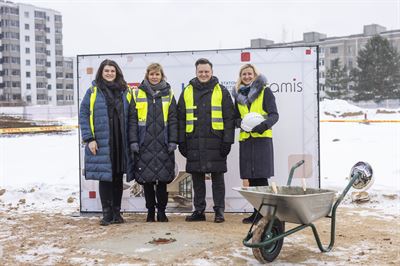
The Nordic Investment Bank has signed an EUR 84 million loan with UAB Vilnius Education Infrastructure to finance construction and operation of nine educational buildings in Vilnius, with a matching EUR 84 million provided by the European Investment Bank. The project will deliver five kindergartens and four schools built over three years and managed for 20 years, providing approximately 4,290 student places (≈3.5% of Vilnius children) — 2,004 general education, 1,710 primary and 576 preschool places from 2028 — and all buildings will meet A++ energy efficiency standards. This is the first project in the region where a municipally owned company independently borrows to finance school infrastructure, aimed at easing overcrowding and reducing reliance on private schools.
Market Structure: The €168m combined NIB+EIB financing creates a localized boom for construction contractors, energy-efficiency subsystem suppliers (HVAC, glazing, MEP), and facilities managers servicing Vilnius; expect direct revenues concentrated 2024–2028 with ongoing operations revenue 2028–2048. Private preschool operators and out-of-district schools face modest enrollment pressure — the project covers ~4,290 students (~3.5% of Vilnius’ children) so competitive impact is neighborhood-level but strategically important in fast-growth districts (Pilaitė, Pašilaičiai, Verkiai).
Risk Assessment: Key tail risks are >20% construction cost overruns, a 100–200bp rise in funding costs that stress the PPP debt service profile, or a municipal budget shortfall that forces renegotiation of 20‑year maintenance contracts; probability low-medium but high impact. Time horizons: market reaction immediate-to-short (procurement wins/losses, 0–6 months), revenue recognition mid-term (contractor revenues 6–36 months), cashflow/ESG benefits long-term (post‑2028 operations). Hidden dependency: project viability hinges on Vilnius’ operating subsidies and enrollment forecasts — underperformance in population growth reverses benefits.
Trade Implications: Favor exposure to high-ESG Northern European builders with Baltic footprints and to credit‑rating/ESG analytics firms that win work on PPP structuring. Expect modest downward pressure on regional municipal bond spreads as supranationals validate borrower credit; commodities impact (cement/steel) is incremental and localized.
Contrarian Angle: Consensus treats this as a social/ESG win; investors may underprice project execution risk and contingent municipal obligations. If the model proves scalable across Baltics, select winners’ multiples could rerate by +10–30% over 12–36 months; conversely, one high-profile cost overrun could materially widen regional municipal spreads and create short opportunities.
AI-powered research, real-time alerts, and portfolio analytics for institutional investors.
Request DemoOverall Sentiment
mildly positive
Sentiment Score
0.30
Ticker Sentiment
