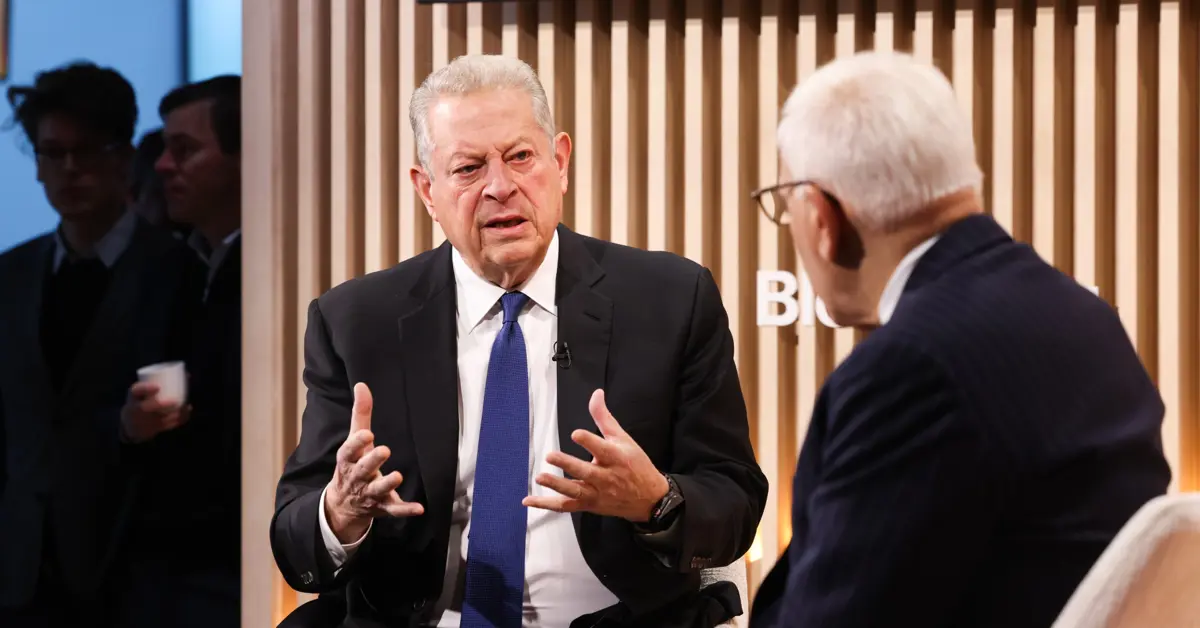
Al Gore, chairman of Generation Investment Management and former US vice president, condemned the Trump administration’s campaign to block offshore wind as “insane,” arguing renewables are indispensable to ongoing electrification. Federal judges have recently allowed projects in New York, Rhode Island and Virginia to resume construction, but the administration says it will continue legal challenges on unspecified national-security grounds, maintaining regulatory uncertainty for developers and investors. Gore warned that reduced clean-energy investment would accelerate climate risks, exacerbate extreme weather and mass migration, and cede clean-tech advantage to competitors such as China, underscoring policy risk and strategic importance for green-focused capital allocators.
Market structure: Policy uncertainty around US offshore wind creates asymmetric outcomes — incumbent project developers and European turbine/cable suppliers (e.g., ORSTED.CO, VWS.CO, PRY.MI, NEX.PA) are direct beneficiaries if courts/administration relent, while US-focused coastal utilities with large fossil portfolios (XOM, CVX) and small regional developers face demand drag. Pricing power shifts to large vertically integrated suppliers (Vestas, Ørsted, Prysmian) that control turbine supply and export cable capacity; expect 5–15% premium on orderbacklog value vs pure-build contractors over 6–24 months. Supply/demand: delays compress effective turbine and cable supply into a shorter window once approvals return, risking 10–25% cost inflation and longer delivery lead times through 2027. Cross-asset: anticipate tighter credit spreads on investment-grade green bonds for large developers, modest bullish pressure on copper/steel (1–3% incremental demand), and FX tailwinds for EUR/DKK vs USD if European manufacturers win US contracts.
Risk assessment: Tail risks include permanent project cancellations (stranding 20–40% of US pipeline) and punitive regulatory rulings that raise insurance/financing costs by 200–500 bps; probability medium (20–30%) over 12–24 months. Immediate (days–weeks) risk is volatility around court rulings; short-term (months) is permitting and CapEx re-phasing; long-term (years) is election/legislative shifts that can flip support. Hidden dependencies: port upgrades, cable capacity, vessel availability and long-lead turbine orders — failures here magnify cost overruns. Catalysts: definitive appellate court decisions (30–90 days), DOE/FEMA technical memos (90–180 days), and state off-take approvals accelerate or reverse trends.
Trade implications: Direct plays — establish 2–3% portfolio longs in ORSTED.CO and NEE (NextEra) with 12–18 month horizon targeting 20–35% upside if projects proceed; hedge with 0.5–1% purchase of 6–9 month put protection at 15% OTM. Pair trade — long PRY.MI (cables) vs short XOM (energy major) 1:1 notional for 12 months to express procurement squeeze; target relative outperformance +10–15% annualized. Options — buy 6-month call spreads on ORSTED.CO (buy 20% OTM / sell 40% OTM) sized to 1–2% notional to capture binary rulings while limiting premium. Sector rotation — shift 3–5% from traditional oil&gas capex names into utilities/renewable suppliers over next 3–12 months. Entry/exit — step in on post-ruling volatility within 5–15% moves; trim by half at 15% profit and exit fully at 30–35%.
Contrarian angles: Consensus focuses on political headlines; it underprices the structural supply choke-points that favor large OEMs and cable makers — these companies can re-price contracts and capture margin expansion even if US buildouts pause. Reaction may be underdone for European suppliers (ORSTED, VWS, PRY) whose orderbooks are long; short-term headline-driven selloffs are buying windows rather than signal of permanent demand collapse. Historical parallel: 2010–2013 US shale permitting swings created multi-year vendor consolidation and margin expansion for global service providers — offshore could follow, concentrating market share. Unintended consequence: over-investment in onshore substitutes (gas peakers) could create stranded gas assets if wind resumes, amplifying downside for select utilities and oil majors.
AI-powered research, real-time alerts, and portfolio analytics for institutional investors.
Request DemoOverall Sentiment
mildly positive
Sentiment Score
0.25
